


[ARCHIVED THREAD] - The Official Nixie Tube Thread (Page 1 of 4)
Posted: 8/27/2016 11:42:55 PM EDT
|
How about a breather from the "Breaking Trump Pepe BLM Soros Alinsky Crooked Hillary Millennial Bash Baby Boomer Bash Dinosaurs in Africa Burkini Atheist Tranny Beheading" threads?
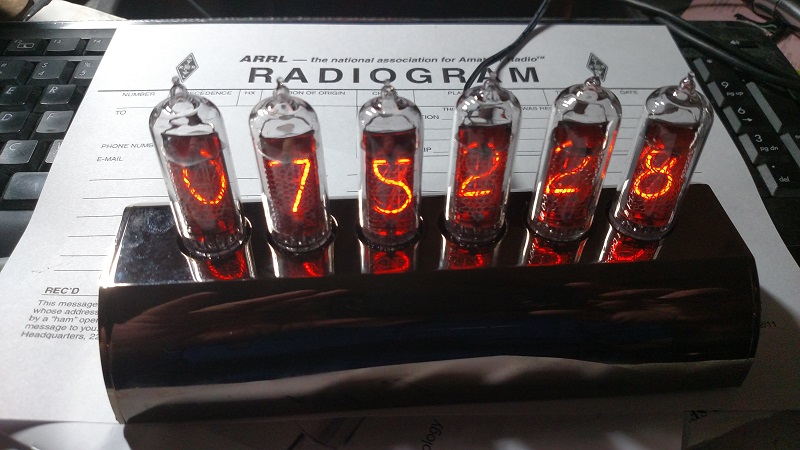
Back in this thread, a feller by the name of SuperJanitor forever ruined me! I made my first one as a Christmas present last year for a fellow Arfcommer, then I made one for myself, and I just finished up one for my mom's birthday, as she'd seen the first one I made and said it was cool. Maybe she was bullshitting, but I guess that will teach her. Also, this SuperJanitor dude just sent me this badass oscilloscope a couple of days ago after finding out I didn't have one while trying to help me trouble shoot some clock issues. He wouldn't accept payment, he said just donate some money to my local animal shelter. I tell ya, Arfcommers have to be some of the most humble and generous people out there. I'm constantly amazed at the things that are done for myself and others on this site. Let's take a break from all this election cycle turmoil, and enjoy some nixies! For those interested, I got my kits from PV Electronics. They offer great kits and customer service. SuperJanitor is waaaaay more advanced and builds his from scratch. Only do this if you're a badass. 
This is now my alarm clock: 

This is my mom's birthday present: 


And here's my new oscilloscope: 
|
|
Quoted: Yes, that would be cool...but she's only getting a nixie clock.  Quoted: Quoted: Quoted: YOU MADE YOUR MOM AN OSCILLOSCOPE? Your mom must be pretty damn cool!!!! DAMN!!! Yes, that would be cool...but she's only getting a nixie clock. Dude...it is SWEEEEEEEEEEEET!!!!! I LOVE Nixie Tubes!!!!! |
|
Quoted:
OST, been wanting to build one for years now. If I can do it, anyone can. I really didn't know jack shit about electronics or anything like that prior to SJ's thread. I'm now hooked. I've also been bit by the ham radio bug. I'm taking my test here in the next couple weeks for my tech license. Our ham forum here helped me out with that a lot. |


|
Quoted:
Yes, that would be cool...but she's only getting a nixie clock. Quoted:
Quoted:
Quoted:
YOU MADE YOUR MOM AN OSCILLOSCOPE? Your mom must be pretty damn cool!!!! DAMN!!! Yes, that would be cool...but she's only getting a nixie clock. only? it's cool as hell |
|
Quoted:
Here's my latest toy  It's an oscilloscope clock! It takes advantage of your scope's XY function to analyze Lissajous paterns. It's an oscilloscope clock! It takes advantage of your scope's XY function to analyze Lissajous paterns.
http://i67.tinypic.com/2nkmm4n.jpg http://i67.tinypic.com/iwkdgo.jpg http://i66.tinypic.com/260fxw7.jpg http://i67.tinypic.com/2daerz4.jpg http://i68.tinypic.com/nyse9s.jpg  https://youtu.be/Fxx70xT5D2U https://youtu.be/Fxx70xT5D2U
Must.....resist....temptation. 
|
|
Quoted:
They are pretty useless. Comrade can send them to me for proper disposal. I have been searching for these but prices are pretty crazy. Quoted:
Quoted:
I got a box of nixie tubes but haven't got around to building anything with them yet. They are pretty useless. Comrade can send them to me for proper disposal. I have been searching for these but prices are pretty crazy. Some designs cost more than others. The little kit I made for my mom uses IN-12 tubes. They're not too expensive. |
|
Quoted: Must.....resist....temptation. Quoted: Quoted: Here's my latest toy It's an oscilloscope clock! It takes advantage of your scope's XY function to analyze Lissajous paterns.http://i67.tinypic.com/2nkmm4n.jpg http://i67.tinypic.com/iwkdgo.jpg http://i66.tinypic.com/260fxw7.jpg http://i67.tinypic.com/2daerz4.jpg http://i68.tinypic.com/nyse9s.jpg https://youtu.be/Fxx70xT5D2UMust.....resist....temptation. |
|
Quoted: They are pretty useless. Comrade can send them to me for proper disposal. I have been searching for these but prices are pretty crazy. Quoted: Quoted: I got a box of nixie tubes but haven't got around to building anything with them yet. They are pretty useless. Comrade can send them to me for proper disposal. I have been searching for these but prices are pretty crazy. |

|
Quoted:
Hell,I remember when gas pumps were full of them. Same here. Different thing though making your own clock or stopwatch or whatever with them from kit or from scratch. Seeing/using them is different than building with them. A lot of the gas pumps switched to VFD (Vacuum Flourescent Displays) which were the glowy teal/yellow/amber between the rotating numbers era (70s) and LCD era (2000s). I really like VFDs, there's a reason a lot of stock radios in cars still use them as the main display. Very bright, but dimmable, and a lot harder to use than Nixie due to number of elements needing a signal. Nixie tubes have one color and brightness, the only downfall. |
|
Quoted:
That is cool, but I would never keep my scope on just for a clock. Quoted:
Quoted:
Quoted:
Here's my latest toy It's an oscilloscope clock! It takes advantage of your scope's XY function to analyze Lissajous paterns.
http://i67.tinypic.com/2nkmm4n.jpg http://i67.tinypic.com/iwkdgo.jpg http://i66.tinypic.com/260fxw7.jpg http://i67.tinypic.com/2daerz4.jpg http://i68.tinypic.com/nyse9s.jpg https://youtu.be/Fxx70xT5D2U
Must.....resist....temptation. I've got an older scope I'm gonna display the clock on. I think I will put it on the bench in my garage, it'll be a cool looking conversation piece
ETA, I'll probably just power it up when I'm out there. The clock will hold memory when off. |

|
Quoted:
In the kit you bought did they provide the source code so you can modify and customize how it's programmed? I think Pete's kits are proprietary, but there are open source kits available out there. This is an area of weakness for me. I am pretty good at making circuits from schematics and even scratch sometimes, but I am an idiot when it comes to code and programming. I've watched a couple of tutorials, but I'm still scratching my head sometimes trying to put it into practice. Microcontrollers and platforms such as arduino really can open up a whole new world. |
Here is a little home brew gizmo I threw together to check nixie tubes. It consists of a boost converter to step up the voltage (9 volts in this case) to about 180 volts. It is capable of boosting to 450 volts, but that is waaay more than I need here. It also has a counting circuit made form a 4017 decade counter clocked by a 555 timer running astable.


I'll try and get some pics of some tubes that have different characters than numbers in them a little later. |
|
Quoted:
This is super cool have you thought about talking the the folks at EE Times they would love this Adam Quoted:
Quoted:
Here's my latest toy It's an oscilloscope clock! It takes advantage of your scope's XY function to analyze Lissajous paterns. This is super cool have you thought about talking the the folks at EE Times they would love this Adam It's a kit. I got it here...... http://dutchtronix.com/ScopeClockH3-1-Enhanced.htm |
|
I remember when main frame computers (there was no other kind) had nixie tube displays.
But in those days the characters had no curves. They were composed of 7 straight line segments. When all 7 segments were lit, they made an "8". Prior to nixie tubes and Fortran, programming was in hexadecimal in the early days and the displays were just a bunch of tiny little bulbs (in lines of 8 to represent each character as I recall.) 
|
|
Quoted:
Here is a little home brew gizmo I threw together to check nixie tubes. It consists of a boost converter to step up the voltage (9 volts in this case) to about 180 volts. It is capable of boosting to 450 volts, but that is waaay more than I need here. It also has a counting circuit made form a 4017 decade counter clocked by a 555 timer running astable. http://i65.tinypic.com/dq40g8.jpg https://youtu.be/pj7ws3zzVvI
I'll try and get some pics of some tubes that have different characters than numbers in them a little later. You REALLY need to learn code, it's VERY easy to get something working, even if not totally perfect efficient. That bundle of wires and ICs would be a single IC with a PICAXE (Programmed in BASIC) or Arduino (Where source code for just about anything already exists). No need to get into Linux and programming with a Raspberry Pi, just stick with PICAXE or Arduino and you'll be fine. Think of it as a super custom IC to do exactly what you want it to. The programs are literally click and go. PICAXE is a Microchip PIC microcontroller that is directly programmed in Basic and used like an IC once programmed, nothing else needed. 8 to 40 pin versions available. Arduino is an Atmel microcontroller Plus the board/oscillator/I/O mapped out to a standard format to make things easier for a beginner using "Shields" that plug into all the IO as a stack.. The Arduino Nano is on a 40 pin carrier and can be used like an IC in circuit as well. These are programmed in C, but with a LOT of pre-build libraries to make things super easy if not super efficient. Either is good for a beginner. I like using a PIC with C, but PIXAXE has some positives, so does the Arduino. Get Both is an easy option for under $25 ! Some example projects: Do NOT go to instructables! That's like the teenager version of stuff! Some good ideas, but circuits and source code are often luck vs. skill with many 'bad' designs. PICAXE: PICAXE Projects with source code Arduino: <most of The Internet here...> Arduino Nixie "Shield" page Source Code for Nixie Clock |
|
Quoted:
I think Pete's kits are proprietary, but there are open source kits available out there. This is an area of weakness for me. I am pretty good at making circuits from schematics and even scratch sometimes, but I am an idiot when it comes to code and programming. I've watched a couple of tutorials, but I'm still scratching my head sometimes trying to put it into practice. Microcontrollers and platforms such as arduino really can open up a whole new world. Quoted:
Quoted:
In the kit you bought did they provide the source code so you can modify and customize how it's programmed? I think Pete's kits are proprietary, but there are open source kits available out there. This is an area of weakness for me. I am pretty good at making circuits from schematics and even scratch sometimes, but I am an idiot when it comes to code and programming. I've watched a couple of tutorials, but I'm still scratching my head sometimes trying to put it into practice. Microcontrollers and platforms such as arduino really can open up a whole new world. Any recommendations for open source kits? I am a software guy and not much of a hardware guy. 
|
| If you don't want to be bothered making your own, these guys from Poland on Ebay are good vendors. |
|
Quoted:
Any recommendations for open source kits? I am a software guy and not much of a hardware guy.
Quoted:
Quoted:
Quoted:
In the kit you bought did they provide the source code so you can modify and customize how it's programmed? I think Pete's kits are proprietary, but there are open source kits available out there. This is an area of weakness for me. I am pretty good at making circuits from schematics and even scratch sometimes, but I am an idiot when it comes to code and programming. I've watched a couple of tutorials, but I'm still scratching my head sometimes trying to put it into practice. Microcontrollers and platforms such as arduino really can open up a whole new world. Any recommendations for open source kits? I am a software guy and not much of a hardware guy.
This link is all open source, almost plug and play Arduino kit with source code for a Nixie Clock. You'll need to solder a bit, but with standard DIP spacing, it's pretty easy. Never realized how easy until soldering 40 pin QFP ICs that are smaller than your pinky nail (Same IC package that is used on the Arduino Nano, IIRC). 
Once it is together, there are all sorts of things you can do, like pulsating the numbers brighter at each second, all done in code without further hardware work. |
|
Quoted:
When buying tubes from eBay what should I look for? Used/refurbished or new? First, look for US NOS (New Old Stock), those are tubes that were brand new in boxes on the shelf, but 40 years old and they were cleaning out the warehouse. These are hard to find, so if you do, hoard them. Next, the russian tubes are all over. They are valid and many shapes, I just don't like the number designs in many of them. Refurbished is a bit hard to guess at. Once the heater in a tube goes, there's probably not much left in the rest. If you are going to play with the brightness tweaks and other stuff, be sure to have some spares. 
|
|
Quoted:
You REALLY need to learn code, it's VERY easy to get something working, even if not totally perfect efficient. That bundle of wires and ICs would be a single IC with a PICAXE (Programmed in BASIC) or Arduino (Where source code for just about anything already exists). No need to get into Linux and programming with a Raspberry Pi, just stick with PICAXE or Arduino and you'll be fine. Think of it as a super custom IC to do exactly what you want it to. The programs are literally click and go. PICAXE is a Microchip PIC microcontroller that is directly programmed in Basic and used like an IC once programmed, nothing else needed. 8 to 40 pin versions available. Arduino is an Atmel microcontroller Plus the board/oscillator/I/O mapped out to a standard format to make things easier for a beginner using "Shields" that plug into all the IO as a stack.. The Arduino Nano is on a 40 pin carrier and can be used like an IC in circuit as well. These are programmed in C, but with a LOT of pre-build libraries to make things super easy if not super efficient. Either is good for a beginner. I like using a PIC with C, but PIXAXE has some positives, so does the Arduino. Get Both is an easy option for under $25 ! Some example projects: Do NOT go to instructables! That's like the teenager version of stuff! Some good ideas, but circuits and source code are often luck vs. skill with many 'bad' designs. PICAXE: PICAXE Projects with source code Arduino: <most of The Internet here...> Arduino Nixie "Shield" page Source Code for Nixie Clock Quoted:
Quoted:
Here is a little home brew gizmo I threw together to check nixie tubes. It consists of a boost converter to step up the voltage (9 volts in this case) to about 180 volts. It is capable of boosting to 450 volts, but that is waaay more than I need here. It also has a counting circuit made form a 4017 decade counter clocked by a 555 timer running astable. http://i65.tinypic.com/dq40g8.jpg https://youtu.be/pj7ws3zzVvI
I'll try and get some pics of some tubes that have different characters than numbers in them a little later. You REALLY need to learn code, it's VERY easy to get something working, even if not totally perfect efficient. That bundle of wires and ICs would be a single IC with a PICAXE (Programmed in BASIC) or Arduino (Where source code for just about anything already exists). No need to get into Linux and programming with a Raspberry Pi, just stick with PICAXE or Arduino and you'll be fine. Think of it as a super custom IC to do exactly what you want it to. The programs are literally click and go. PICAXE is a Microchip PIC microcontroller that is directly programmed in Basic and used like an IC once programmed, nothing else needed. 8 to 40 pin versions available. Arduino is an Atmel microcontroller Plus the board/oscillator/I/O mapped out to a standard format to make things easier for a beginner using "Shields" that plug into all the IO as a stack.. The Arduino Nano is on a 40 pin carrier and can be used like an IC in circuit as well. These are programmed in C, but with a LOT of pre-build libraries to make things super easy if not super efficient. Either is good for a beginner. I like using a PIC with C, but PIXAXE has some positives, so does the Arduino. Get Both is an easy option for under $25 ! Some example projects: Do NOT go to instructables! That's like the teenager version of stuff! Some good ideas, but circuits and source code are often luck vs. skill with many 'bad' designs. PICAXE: PICAXE Projects with source code Arduino: <most of The Internet here...> Arduino Nixie "Shield" page Source Code for Nixie Clock Yes I really need to do this! Making parts from discretes and "dumb" ICs don't bother me much though I enjoy soldering and it's kind of a nice reward seeing a jumbled mess come alive when you're finished. Knowing how to properly use a PIC or arduino would really open a lot of doors though. ETA, if you think my checker was a jumbled mess of wire, check out the clock circuit I built a while back!


|
|
Quoted:
First, look for US NOS (New Old Stock), those are tubes that were brand new in boxes on the shelf, but 40 years old and they were cleaning out the warehouse. These are hard to find, so if you do, hoard them. Next, the russian tubes are all over. They are valid and many shapes, I just don't like the number designs in many of them. Refurbished is a bit hard to guess at. Once the heater in a tube goes, there's probably not much left in the rest. If you are going to play with the brightness tweaks and other stuff, be sure to have some spares.
Quoted:
Quoted:
When buying tubes from eBay what should I look for? Used/refurbished or new? First, look for US NOS (New Old Stock), those are tubes that were brand new in boxes on the shelf, but 40 years old and they were cleaning out the warehouse. These are hard to find, so if you do, hoard them. Next, the russian tubes are all over. They are valid and many shapes, I just don't like the number designs in many of them. Refurbished is a bit hard to guess at. Once the heater in a tube goes, there's probably not much left in the rest. If you are going to play with the brightness tweaks and other stuff, be sure to have some spares.
I think you are thinking of vacuum tubes. Nixes are cold cathode devices. Cathode "poisoning" (degradation of the cathode due to individual digits being lit for extended period of time), over-driving them and out-gassing is what destroys them. They have an internal low pressure atmosphere of a neon gas. I ruined a couple once by trying to adjust them once they were soldered on the board. I thought there was enough slack in the flying leads to try and tweak them. What I did was compromise the seal. It wasn't long after that the two tubes stopped working. |
|
Quoted:
I think you are thinking of vacuum tubes. Nixes are cold cathode devices. Cathode "poisoning" (degradation of the cathode due to individual digits being lit for extended period of time), over-driving them and out-gassing is what destroys them. They have an internal low pressure atmosphere of a neon gas. I ruined a couple once by trying to adjust them once they were soldered on the board. I thought there was enough slack in the flying leads to try and tweak them. What I did was compromise the seal. It wasn't long after that the two tubes stopped working. Quoted:
Quoted:
Quoted:
When buying tubes from eBay what should I look for? Used/refurbished or new? First, look for US NOS (New Old Stock), those are tubes that were brand new in boxes on the shelf, but 40 years old and they were cleaning out the warehouse. These are hard to find, so if you do, hoard them. Next, the russian tubes are all over. They are valid and many shapes, I just don't like the number designs in many of them. Refurbished is a bit hard to guess at. Once the heater in a tube goes, there's probably not much left in the rest. If you are going to play with the brightness tweaks and other stuff, be sure to have some spares.
I think you are thinking of vacuum tubes. Nixes are cold cathode devices. Cathode "poisoning" (degradation of the cathode due to individual digits being lit for extended period of time), over-driving them and out-gassing is what destroys them. They have an internal low pressure atmosphere of a neon gas. I ruined a couple once by trying to adjust them once they were soldered on the board. I thought there was enough slack in the flying leads to try and tweak them. What I did was compromise the seal. It wasn't long after that the two tubes stopped working. You are correct. I was thinking "tubes" in the pre-arduino sense, guitar amps and RF transmitters. |
|
Quoted: ok, who wants to point me in the direction of a fairly simple, fairly reasonably priced kit for a clock? I have the Fun Clock kit from PV. Shipping from UK was pretty quick. It's one of the lower cost kits. It was ~$60US. I haven't started it yet. http://www.pvelectronics.co.uk/index.php?main_page=product_info&cPath=1&products_id=140&zenid=4d4669878a649a7a60bebe9fb4724720 |
|
Quoted:
ok, who wants to point me in the direction of a fairly simple, fairly reasonably priced kit for a clock? Depends on "Reasonable", the case and final appearance really drives the cost up quick. The electronics are pretty cheap, even at a markup. There is This place Suggested from This Site |
|
Quoted:
Here are some other symbol and characters on a couple tubes I have. Some of these would come in handy if I ever build a retro volt meter or frequency counter. https://youtu.be/7Rdj7v5Khp4Quoted since I have a plugin clash or something that doesn't allow me to see embed videos on ARFCOM only. 
|