


Posted: 10/26/2009 10:56:32 AM EDT
|
I keep seeing these commercials for CSX trains moving 1 ton of frieght over 400 miles on 1 gallon of fuel.
How the hell do they do that? And why can't i move my pickup truck, that wieghs 1 ton over 400 miles on 1 gallon of fuel? |
|
Quoted:
I keep seeing these commercials for CSX trains moving 1 ton of frieght over 400 miles on 1 gallon of fuel. How the hell do they do that? And why can't i move my pickup truck, that wieghs 1 ton over 400 miles on 1 gallon of fuel? Because your pickup uses high friction rubber tires and the train uses low friction steel on steel wheels. ETA: Beat by 27 seconds! Damn you! |
|
Depends on the terrain. When I ran engines for the Union Pacific, over mountain grade territory, we averaged 1100 gallons of fuel used per locomotive on our heavy trains. Soooooo, 15k tons of freight moved for 176 miles having used 3300 gallons of diesel (average of three big AC motors in the consist for heavy trains). ETA: Our hotshots that ran the 310 mile trek from Cheyenne to Green River didn't use much more diesel at 70 mph, but their loads were not as cumbersome as a Soda Ash or Grain train. |
|
Quoted:
Quoted:
I keep seeing these commercials for CSX trains moving 1 ton of frieght over 400 miles on 1 gallon of fuel. How the hell do they do that? And why can't i move my pickup truck, that wieghs 1 ton over 400 miles on 1 gallon of fuel? Because your pickup uses high friction rubber tires and the train uses low friction steel on steel wheels. ETA: Beat by 27 seconds! Damn you! And roller bearings. |
|
Quoted:
Because 1 ton on a train is negligible. Multiply that times what it can carry and it makes sense. It's the wording that makes it sound so super special. ETA: And since it's a train thread... 
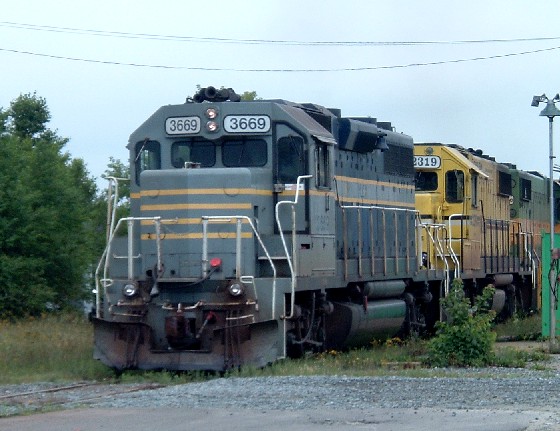
http://www.traingeek.ca/blogpix/3669%20McAdam%2020050813%20SLB%201.jpg This, 1 ton on a train is equal to say, the lug nuts on 1 wheel on your truck, maybe even just 1 lug nut |
|
Plus, even on our Mountain Grade district, grades rarely exceed 1.5% Quoted: Quoted: Because 1 ton on a train is negligible. Multiply that times what it can carry and it makes sense. It's the wording that makes it sound so super special. ETA: And since it's a train thread... http://www.traingeek.ca/blogpix/3669%20McAdam%2020050813%20SLB%201.jpg This, 1 ton on a train is equal to say, the lug nuts on 1 wheel on your truck, maybe even just 1 lug nut |
|
Quoted:
I keep seeing these commercials for CSX trains moving 1 ton of frieght over 400 miles on 1 gallon of fuel. How the hell do they do that? And why can't i move my pickup truck, that wieghs 1 ton over 400 miles on 1 gallon of fuel? I doubt a train would go anywere on literally just one gallon of fuel. However, they can take thousands of tons many miles on hundreds of gallons of fuel. I haven't done the math recently but a modern airplane should get over 50 miles per gallon per passenger. |
|
They win points with the "Green" crowd, and those that do business with them. Believe it or not, the Union Pacific (which I was employed with for three years), and all of the COal mines in the Powder River Basin spend millions upon millions marketing themselves as "Greener than the alternative". We literally have customers of the mine that I work for that will not sign a new contract without ISO4001 certifications, and a good record with DEQ. Quoted: What i want to know is why CSX is running commercials at all. What do they have to gain by spending millions on ad time? |
|
Not only rolling resistance is much lower (steel on steel compared to rubber on concrete) but a long train has very good aerodynamics. It has similar cross sectional area as a truck but is much longer. The skin friction added by each car is tiny compared to the whole. Trains also have much more gradual gradients than what is allowed even on Interstate Highway System. |
|
Quoted: they are hybrids. diesel electric locomotive + low rolling friction + flat surface + little stop and go traffic (all highway milage) = good milage per ton. No, they are for the most part, diesel electric. They don't have any significant battery storage. While the traction motors function as generators for braking, the power produced is dumped to resistor banks, dissipated as heat. There are some hybrids out there BUT the switching/inverters/rectifiers needed are huge. |
|
Quoted: Quoted: they are hybrids. diesel electric locomotive + low rolling friction + flat surface + little stop and go traffic (all highway milage) = good milage per ton. No, they are for the most part, diesel electric. They don't have any significant battery storage. While the traction motors function as generators for braking, the power produced is dumped to resistor banks, dissipated as heat. There are some hybrids out there BUT the switching/inverters/rectifiers needed are huge. Very true. |
|
Quoted:
Quoted:
Quoted:
I keep seeing these commercials for CSX trains moving 1 ton of frieght over 400 miles on 1 gallon of fuel. How the hell do they do that? And why can't i move my pickup truck, that wieghs 1 ton over 400 miles on 1 gallon of fuel? Because your pickup uses high friction rubber tires and the train uses low friction steel on steel wheels. ETA: Beat by 27 seconds! Damn you! And roller bearings. All cars/trucks use roller bearings. The difference would be wheel circumference. A train at 70 mph would have its wheels spinning a lot fewer RPMs than those little guys they stick on small utility trailers. High speed trains that don't carry a lot of weight take it one step further, and use tapered wheels, thereby making an even smaller contact patch with the steel rails. |
|
All train wheels have tapered contact areas, that is how they get around long curves without a differential, or derailing. The contact area of a train wheel is approximately the size of a dime, and we use sanders on the locomotives for traction (this includes automatic sanders, which, in the case of newer computerized locomotives, detects wheel slip and applies sand as needed. Quoted: Quoted: Quoted: Quoted: I keep seeing these commercials for CSX trains moving 1 ton of frieght over 400 miles on 1 gallon of fuel. How the hell do they do that? And why can't i move my pickup truck, that wieghs 1 ton over 400 miles on 1 gallon of fuel? Because your pickup uses high friction rubber tires and the train uses low friction steel on steel wheels. ETA: Beat by 27 seconds! Damn you! And roller bearings. All cars/trucks use roller bearings. The difference would be wheel circumference. A train at 70 mph would have its wheels spinning a lot fewer RPMs than those little guys they stick on small utility trailers. High speed trains that don't carry a lot of weight take it one step further, and use tapered wheels, thereby making an even smaller contact patch with the steel rails. |
|
Quoted: 1/400 - That is only true if its already rolling at constant speed on a level grade. Figure in the amount of fuel needed to get that beast moving, and add a slight grade, and you ain't gonna get those magical numbers anymore. Hills are for the most part, neutral because throttle will be reduced when going down. But steep mountain passes are not because braking (dynamic) dissipates the potential energy. |
|
Quoted: It's not friction, it's not aerodynamics, it's scale. A loaded rail car is +/- 200,000 lbs. % cars is 1,000,000. Etc. Get them moving down the track and that's where the savings come. My Peterbilt is more efficient per ton/mile than a Prius. Etc. -p. Yes, it is scale. And there, aerodynamics plays an important part. Ever hear of drafting? That is what each car is doing. |
|
Unless it is a stiff side or front wind....we have had double-stack intermodal trains, without enough motors, barely pull 40 mph (these are almost always 70 mph trains) in a stiff wind. You are almost always fighting the wind on a train in WY, although it can serve as a great tail wind at times. Quoted: Quoted: It's not friction, it's not aerodynamics, it's scale. A loaded rail car is +/- 200,000 lbs. % cars is 1,000,000. Etc. Get them moving down the track and that's where the savings come. My Peterbilt is more efficient per ton/mile than a Prius. Etc. -p. Yes, it is scale. And there, aerodynamics plays an important part. Ever hear of drafting? That is what each car is doing. |
|
Quoted:
All train wheels have tapered contact areas, that is how they get around long curves without a differential, or derailing. The contact area of a train wheel is approximately the size of a dime, and we use sanders on the locomotives for traction (this includes automatic sanders, which, in the case of newer computerized locomotives, detects wheel slip and applies sand as needed. So is it the degree of taper that matters? I thought a differentiating factor between a freight train and a TGV style train was a very small contact surface (smaller than the dime you describe). |
|
We run "Passenger Specials" from our UP historic fleet in Cheyenne, which includes our E-9 streamliners, our steam engines, and passenger cars...we also still run AMTRAK occasionally when the Moffat Tunnel is down for maintenance. The only difference between a passenger and a freight locomotive is the final gearing of the traction motors (or straight gearing of the steam engines), and a whole-lot-less weight for the passenger trains. Your average AMTRAK runs about 20+ H.P. per trailing ton....our average grain train runs about .9 H.P. per Trailing Ton. Remember, though, that back in the heyday of the passenger and mail train, our district was a 100 mph district, although some curves were still 50 mph curves. Our passenger trains are now limited to 79 mph on our district (with the same slow curves), and freight is limited to 70 mph, unless the train speed is slower on your orders. The difference between a district that would run TGV trains, and ours, is, for the most part, the lack of tight curves. Every district has a timetable describing the speeds for the whole district. Think of all of the yellow "We suggest you do 45 mph around this curve" signs...the railroad just enforces it's speed suggestions. Quoted: Quoted: All train wheels have tapered contact areas, that is how they get around long curves without a differential, or derailing. The contact area of a train wheel is approximately the size of a dime, and we use sanders on the locomotives for traction (this includes automatic sanders, which, in the case of newer computerized locomotives, detects wheel slip and applies sand as needed. So is it the degree of taper that matters? I thought a differentiating factor between a freight train and a TGV style train was a very small contact surface (smaller than the dime you describe). |

|
Quoted:
Quoted:
they are hybrids. diesel electric locomotive + low rolling friction + flat surface + little stop and go traffic (all highway milage) = good milage per ton. No, they are for the most part, diesel electric. They don't have any significant battery storage. While the traction motors function as generators for braking, the power produced is dumped to resistor banks, dissipated as heat. There are some hybrids out there BUT the switching/inverters/rectifiers needed are huge. I've seen them burn when they don't get it right. 
They were great motors right up until they caught on fire. |
|
Okay, aerodynamics plays a part, just like the efficiency of the motor, etc. Route planning, load building and grades all have an effect. Rail has improved its efficiency to over 400 miles per ton per gallon by improvements in all of these factors. Even so, the "inefficient" trains of 25 years ago were more efficient than trucks even at 200 miles per ton per gallon. As I said (but did not elaborate enough on) in my previous post, it is the scale . . . because a train can effectively move so much. For math's sake, assume each rail car can hold 40,000 pounds of product (A). A 100-car train will only need but two or three engines to pull this load. And attaching another car, or a dozen cars, does not effect the efficiency of the train by a significant degree. And aerodynamically, adding another car to the end doesn't do much at all. A truck, on the other hand, can only carry 40,000 lbs by law (again, simplifying- though not by much). So you would need 100 trucks to carry the same load. With 100 engines, all getting 6.0-6.5 mpg. And we can carry on this comparison to a pickup truck. A 3/4 ton truck can carry 4,000 pounds of (A). To carry the same as the tractor trailers, it would require 10 pickups. To carry as much as the train, 1,000 pickups would be needed. At 10mpg. And on down to a Prius. 400 pounds is about all you could put in Prius's trunk area - and that would be pushing it. 10,000 Priuses to move the same load. At 50mpg. And on down to a man with a 40-pound rucksack. 100,000 men. Etc. Economies of scale. Remember, trains have big damn 5,000 gallon tanks of fuel and they will burn that frighteningly fast- but they are moving millions and millions of pounds of freight in the process. And an intermodal train will carry 200 trailers much more efficiently than the 200 tractors needed would - but only to the train yards. Trucks still have to get the trailers to the receiver. Fuck, I'm no great scientist or educator. I just drive a truck, so ignore me. -p. |