


Posted: 10/18/2011 7:33:33 PM EDT
I want a good, moderately cheap trauma kit, that has a decent amount of medical supplies so i dont have to add to much more to it, i want to be able to treat from a lost limb to bullet wound to a collapsed lung, i already have a decent amount of medical supplies in my house but i dont want to scaff them all for my B.O.B, so if theres a kit that is a reasonable price  also if they came in a tacticool case that would be good, let me know if i should bump it to the survival outdoor section, but i want you guys to bear in mind that its for my zombie B.O.B also if they came in a tacticool case that would be good, let me know if i should bump it to the survival outdoor section, but i want you guys to bear in mind that its for my zombie B.O.B
|
| My aunt is an ER nurse so im good, and ive had some basic classes, not i cant treat a collapsed lung but id rather have the equipment on hand, and i can do a tournaquet and treat a broken limb or any major lacerations, and for anything else im relying on a coreman field medic guide |
|
Quoted:
My aunt is an ER nurse so im good, and ive had some basic classes, not i cant treat a collapsed lung but id rather have the equipment on hand, and i can do a tournaquet and treat a broken limb or any major lacerations, and for anything else im relying on a coreman field medic guide This whole post. 
Your Aunt is an ER nurse, you're not. Take some classes. The Red Cross offers classes. Join the military and get the training for free. Having the equipment on hand for injuries isn't going to do you any good if you or the people on your fire team don't know WTF is going on or how to treat certain things. And a CORPSMAN, or equivalent, isn't always going to be nearby. |
|
Quoted:
Quoted:
My aunt is an ER nurse so im good, and ive had some basic classes, not i cant treat a collapsed lung but id rather have the equipment on hand, and i can do a tournaquet and treat a broken limb or any major lacerations, and for anything else im relying on a coreman field medic guide Join the military and get the training for free. ...not really free, we the taxpayers are paying for it... 
|
|
Quoted:
Quoted:
My aunt is an ER nurse so im good, and ive had some basic classes, not i cant treat a collapsed lung but id rather have the equipment on hand, and i can do a tournaquet and treat a broken limb or any major lacerations, and for anything else im relying on a coreman field medic guide This whole post.
Your Aunt is an ER nurse, you're not. Take some classes. The Red Cross offers classes. Join the military and get the training for free. Having the equipment on hand for injuries isn't going to do you any good if you or the people on your fire team don't know WTF is going on or how to treat certain things. And a CORPSMAN, or equivalent, isn't always going to be nearby. First of all my aunt lives literally 3 blocks away and I go to basic in In the beginning of next year. As i stated above i have taken classes but as i said they were basic and did not cover reinflating a collapsed lung, (it was for when i learned to scuba dive and when pulling your dive buddy out of the water, you can be the only person on scene for a very long period of time and it was primarily techniques of pulling them out of the water) and again AS stated above id rather have the Medical supplies at hand than not, im not worried about a few extra ounces of weight, sorry about my spelling but you clearly got what i meant, annddd this is the zombie section of the forum so chill out 
|
| If you were to treat a collapsed lung and you saved someones life, and you happen to pierce the nerve running next to the ribs. Then you are not only at risk of malpractice but also practicing medicine without a licence. While people will say you are protected via the good samaritan act any good lawyer can get around that as it is normally applied to CPR and Hiemlich type maneuvers, not invasive needle stabbing. To be honest, an untrained person is likely to do more harm than good by having the supplies and not the knowhow. |
|
Quoted:
test Had a problem responding back and sending a PM to the OP this morning at 0530-ish. Sorry about the lack of smileys and my tone. I was short on caffeine at the time.  Been working 12 hour shifts from 1800-0600 for a base inspection. These hours suck ass. Been working 12 hour shifts from 1800-0600 for a base inspection. These hours suck ass. 
In all the Self Aid and Buddy Care (SABC) training I've had in the Air Force, not one time have we covered re-inflating a collapsed lung. We've covered placing a piece of plastic over a sucking chest wound, but not inflating. We cover pretty much every battlefield/every day injury pretty well...eye injuries, burns, bullet wounds, missing limbs, head injuries, shock. Every other year, we also get CPR trained. We get the training from fellow Airmen, but it's Red Cross certified. I took SCUBA a few months ago. While I remember giving a rescued diver some rescue breathes, I don't remember covering a collapse lung. You'll learn the things you need in basic. What branch are you going in? You said corpsman, so I can only imagine Marine or Navy, but you said basic which covers Air Force and Army. After basic, you'll learn more SABC before you deploy and once a year, Combat Lifesaving. Until then, ask your Aunt to show you some things. Practice on a dummy. Ask her if you can hang out in an ER room. Knowledge is one thing, but having practical hands on training is different. As fair as the misspelled word...seeing as how you're still new, there are grammer Nazis everywhere on this site. I'm not one of them, like I said, I was low on caffeine at 0500.
|
|
Quoted:
Quoted:
test Had a problem responding back and sending a PM to the OP this morning at 0530-ish. Sorry about the lack of smileys and my tone. I was short on caffeine at the time. Been working 12 hour shifts from 1800-0600 for a base inspection. These hours suck ass.
In all the Self Aid and Buddy Care (SABC) training I've had in the Air Force, not one time have we covered re-inflating a collapsed lung. We've covered placing a piece of plastic over a sucking chest wound, but not inflating. We cover pretty much every battlefield/every day injury pretty well...eye injuries, burns, bullet wounds, missing limbs, head injuries, shock. Every other year, we also get CPR trained. We get the training from fellow Airmen, but it's Red Cross certified. I took SCUBA a few months ago. While I remember giving a rescued diver some rescue breathes, I don't remember covering a collapse lung. You'll learn the things you need in basic. What branch are you going in? You said corpsman, so I can only imagine Marine or Navy, but you said basic which covers Air Force and Army. After basic, you'll learn more SABC before you deploy and once a year, Combat Lifesaving. Until then, ask your Aunt to show you some things. Practice on a dummy. Ask her if you can hang out in an ER room. Knowledge is one thing, but having practical hands on training is different. As fair as the misspelled word...seeing as how you're still new, there are grammer Nazis everywhere on this site. I'm not one of them, like I said, I was low on caffeine at 0500. Not a problem its hard to make me take things personally, To Awnser your question; marines and as far as my misuse of terminology; i blame my recruiter tho i feel like thats a typical excuse haha  Im ultimatly (Attempting) to go to sniper school so wish me luck. Ive suprisingly not had it covered in any class ive taken, not for my diving or the medical portion of Lifeguard training. good idea on the hanging out in the ER room but idk how that would fly with her superiors lol, but anyway forgive my 18 and a half year oldness Im ultimatly (Attempting) to go to sniper school so wish me luck. Ive suprisingly not had it covered in any class ive taken, not for my diving or the medical portion of Lifeguard training. good idea on the hanging out in the ER room but idk how that would fly with her superiors lol, but anyway forgive my 18 and a half year oldness
|
|
Quoted:
Quoted:
Quoted:
test Had a problem responding back and sending a PM to the OP this morning at 0530-ish. Sorry about the lack of smileys and my tone. I was short on caffeine at the time. Been working 12 hour shifts from 1800-0600 for a base inspection. These hours suck ass.
In all the Self Aid and Buddy Care (SABC) training I've had in the Air Force, not one time have we covered re-inflating a collapsed lung. We've covered placing a piece of plastic over a sucking chest wound, but not inflating. We cover pretty much every battlefield/every day injury pretty well...eye injuries, burns, bullet wounds, missing limbs, head injuries, shock. Every other year, we also get CPR trained. We get the training from fellow Airmen, but it's Red Cross certified. I took SCUBA a few months ago. While I remember giving a rescued diver some rescue breathes, I don't remember covering a collapse lung. You'll learn the things you need in basic. What branch are you going in? You said corpsman, so I can only imagine Marine or Navy, but you said basic which covers Air Force and Army. After basic, you'll learn more SABC before you deploy and once a year, Combat Lifesaving. Until then, ask your Aunt to show you some things. Practice on a dummy. Ask her if you can hang out in an ER room. Knowledge is one thing, but having practical hands on training is different. As fair as the misspelled word...seeing as how you're still new, there are grammer Nazis everywhere on this site. I'm not one of them, like I said, I was low on caffeine at 0500. Not a problem its hard to make me take things personally, To Awnser your question; marines and as far as my misuse of terminology; i blame my recruiter tho i feel like thats a typical excuse haha Im ultimatly (Attempting) to go to sniper school so wish me luck. Ive suprisingly not had it covered in any class ive taken, not for my diving or the medical portion of Lifeguard training. good idea on the hanging out in the ER room but idk how that would fly with her superiors lol, but anyway forgive my 18 and a half year oldness
Good luck with things. My oldest son has been a Marine for 2 years. He does Artillery. I know if he can make it in the Marines, almost anyone could.  I just hit my 20 years in the AF last weekend. Four more years to go. Ask her anyway about the ER room. The worst they can do is say no. I just hit my 20 years in the AF last weekend. Four more years to go. Ask her anyway about the ER room. The worst they can do is say no.
|
|
My list for a good trauma kit would be
Quick Clot ACE bandage Gauze Betadine tape couple bottles of water Cell phone with GPS If you know how to use them add these Sutures and needle drivers penrose drain lidocaine & syringes/needles any trauma with blood. Rinse with water. Throw betadine all over it. pack a quick clot in the hole. Cover with gauze. Wrap snug (not too tight) with ACE. Call EMS. |
|
Quoted:
My list for a good trauma kit would be Quick Clot ACE bandage Gauze Betadine tape couple bottles of water Cell phone with GPS If you know how to use them add these Sutures and needle drivers penrose drain lidocaine & syringes/needles any trauma with blood. Rinse with water. Throw betadine all over it. pack a quick clot in the hole. Cover with gauze. Wrap snug (not too tight) with ACE. Call EMS. I have no problem with any lacerations or broken bones, just more complicated stuff :) i stiched myself up when i went backpacking (hatchet wound to to the leg) and i was pretty far out there, fortunatly one of my buddies that was with me is learning to be a nurse so he started it and talked me through the rest, it was a good learning experiance and we kept camping! |
|
Quoted:
My list for a good trauma kit would be Quick Clot ACE bandage Gauze Betadine tape couple bottles of water Cell phone with GPS If you know how to use them add these Sutures and needle drivers penrose drain lidocaine & syringes/needles any trauma with blood. Rinse with water. Throw betadine all over it. pack a quick clot in the hole. Cover with gauze. Wrap snug (not too tight) with ACE. Call EMS. Throw in a single bullet in your caliber, in case you get bit. No amount of betadine or sutures will stop the oncoming affects.
ADDED* This is the Zombie forum after all.
|
|
Quoted:
Quoted:
Quoted:
Quoted:
test Had a problem responding back and sending a PM to the OP this morning at 0530-ish. Sorry about the lack of smileys and my tone. I was short on caffeine at the time. Been working 12 hour shifts from 1800-0600 for a base inspection. These hours suck ass.
In all the Self Aid and Buddy Care (SABC) training I've had in the Air Force, not one time have we covered re-inflating a collapsed lung. We've covered placing a piece of plastic over a sucking chest wound, but not inflating. We cover pretty much every battlefield/every day injury pretty well...eye injuries, burns, bullet wounds, missing limbs, head injuries, shock. Every other year, we also get CPR trained. We get the training from fellow Airmen, but it's Red Cross certified. I took SCUBA a few months ago. While I remember giving a rescued diver some rescue breathes, I don't remember covering a collapse lung. You'll learn the things you need in basic. What branch are you going in? You said corpsman, so I can only imagine Marine or Navy, but you said basic which covers Air Force and Army. After basic, you'll learn more SABC before you deploy and once a year, Combat Lifesaving. Until then, ask your Aunt to show you some things. Practice on a dummy. Ask her if you can hang out in an ER room. Knowledge is one thing, but having practical hands on training is different. As fair as the misspelled word...seeing as how you're still new, there are grammer Nazis everywhere on this site. I'm not one of them, like I said, I was low on caffeine at 0500. Not a problem its hard to make me take things personally, To Awnser your question; marines and as far as my misuse of terminology; i blame my recruiter tho i feel like thats a typical excuse haha Im ultimatly (Attempting) to go to sniper school so wish me luck. Ive suprisingly not had it covered in any class ive taken, not for my diving or the medical portion of Lifeguard training. good idea on the hanging out in the ER room but idk how that would fly with her superiors lol, but anyway forgive my 18 and a half year oldness
Good luck with things. My oldest son has been a Marine for 2 years. He does Artillery. I know if he can make it in the Marines, almost anyone could. I just hit my 20 years in the AF last weekend. Four more years to go. Ask her anyway about the ER room. The worst they can do is say no.Thank you very much, and ill definatley ask her, and as far as your son goes, well im sure my parents have similar opinions about me haha, for parents in general i can understand being doubtful about the your kid you remember alll the goofy stuff they did growing up, its hard to imagine them being a marine, its a big step towards growing up haha |
|
Quoted:
Quoted:
My list for a good trauma kit would be Quick Clot ACE bandage Gauze Betadine tape couple bottles of water Cell phone with GPS If you know how to use them add these Sutures and needle drivers penrose drain lidocaine & syringes/needles any trauma with blood. Rinse with water. Throw betadine all over it. pack a quick clot in the hole. Cover with gauze. Wrap snug (not too tight) with ACE. Call EMS. Throw in a single bullet in your caliber, in case you get bit. No amount of betadine or sutures will stop the oncoming affects.
ADDED* This is the Zombie forum after all. Hopefully ill be 21 so i can have pistols  Derringer .22 magnum or a small frame .38 special thats staying in the boot for just such an occasion Derringer .22 magnum or a small frame .38 special thats staying in the boot for just such an occasion
|
|
Quoted:
Quoted:
Quoted:
My aunt is an ER nurse so im good, and ive had some basic classes, not i cant treat a collapsed lung but id rather have the equipment on hand, and i can do a tournaquet and treat a broken limb or any major lacerations, and for anything else im relying on a coreman field medic guide This whole post.
Your Aunt is an ER nurse, you're not. Take some classes. The Red Cross offers classes. Join the military and get the training for free. Having the equipment on hand for injuries isn't going to do you any good if you or the people on your fire team don't know WTF is going on or how to treat certain things. And a CORPSMAN, or equivalent, isn't always going to be nearby. First of all my aunt lives literally 3 blocks away and I go to basic in In the beginning of next year. As i stated above i have taken classes but as i said they were basic and did not cover reinflating a collapsed lung, (it was for when i learned to scuba dive and when pulling your dive buddy out of the water, you can be the only person on scene for a very long period of time and it was primarily techniques of pulling them out of the water) and again AS stated above id rather have the Medical supplies at hand than not, im not worried about a few extra ounces of weight, sorry about my spelling but you clearly got what i meant, annddd this is the zombie section of the forum so chill out As an EMT-B, you will learn how to deal with a collapsed lung. They will teach you about sucking chest wounds and how to apply an occlusive dressing in the event the pleural wall is punctured. They will also teach you what to do if it goes tension. Needle decompression is beyond Basic scope of practice though. Of course with anything, whether it be ARS or plastic wrapper, it doesn't "fix" anything. It only helps stabilize the patient until they are able to receive definitive care. So plan accordingly. |
|
I would say pickup an IFAK, great first aid kit that you will learn how to use shortly.
I would highly advise AGAINST quick clot, it does more damage than good. take first aid courses, SABC in the Corps, and volunteer to be First Aid instructors later on will help immensely. I am an SABC instructor (which equates to you should know more than your average Airmen) and a Rescue Diver and Divemaster (which teaches you to care for a diver having issues, or respond to a medical emergency but I dont remember re inflating a lung.. only providing O2). Honestly when Zed comes if you dont have a medic or trauma doc as part of your group, plus the necessary equipment you might as well consider yourself boned. A bullet to any muscle can lead to serious issues down the line, let alone heavy trauma... like someone stated, include an Opt-Out bullet for yourself, because the chance of hell beats the chance of being part of hell on earth. |
|
Quoted:
I would highly advise AGAINST quick clot, it does more damage than good. I'm trying to understand this statement. If someone is bleeding out, and you shove a clotting product in the wound and apply compression, how does it do harm? The clot can be washed out when they get to surgery. edit: found this on the quick clot website. Evidently they used to have an old formula of quick clot that caused chemical burns. But the new formula does not. Does it burn? NO. The first generation of the QuikClot granular product, made from non-hydrated zeolite, was discontinued in 2008 when the hemostatic gauze formulation based on kaolin was introduced. That earlier granular product could cause exothermic reactions if not used properly. |
|
any sort of granular hemostatic clotting agent is bad, as it can be swept by the wind into your eyes, or cause damage to veins and arteries through the heat it produces. Combat gauze and gaze based clotting agents are the new hotness.
I would suggest checking the outdoors forum for any one of the bazillion threads on personal trauma kits. Here's my cut and paste response for these types of threads. I keep a basic bloodstopper kit on my plate carrier, and extra tourniquets all over. A larger CLS style aid bag is never far, there is one in every vehicle I am in both work and personal. My personal kit consists of: HSGI bleeder pouch trauma shears 4" israeli pressure dressing S-rolled gauze combat gauze additional pouch with SOFT-T tourniquet velcro tourniquet on belt extra CAT tourniquets on body armor, pants pocket, and pack I keep sterile gloves in another pouch as I use them a lot for non-medical reasons Your main priority should be to stop bleeding and get them or yourself to better care, be it a larger aid bag or an actual facility. This requires tourniquets, gauze, hemostatic dressings (combat gauze or celox wrap), and pressure dressings combined with both direct and indirect pressure. A larger CLS bag should carry everything else such as occlusive dressings, NPA's, SAM splints, kerlix or rolled gauze, water gel, durapore tape, tegaderm, chest seals such as hyfin or bolin seals, and extra tourniquets. Once you get the absolute necessities you worry about the small stuff like bandages, alcohol wipes, sterile gloves, stomach pads, etc. Needles for chest decompression are good, but you definitely need to take a class on how to use them. Avoid powdered hemostatic agents such as powdered celox as they can blow into your eyes or cause scarring to the veins and arteries due to the heat they generate when solidifying. Avoid hemcon products on ebay as they can kill people with shellfish allergies. Hemostatic gauze is the best thing going right now. From the looks of your first aid kit I would suggest that you do some research and try to figure out how to use this stuff if you don't already know. You can search for the army's TCCC/CLS courses, they are a quick and dirty guide for the average joe on how to save someone's life in trauma situations. Even learning seemingly simple things like where and how to apply tourniquets is extremely vital. The neosporin and band-aids aren't going to do shit in the event of a GSW or car accident, so its good you are looking into expanding your capabilities. Here are some open source references to immediate trauma care, and publications which can illustrate how to use some of these medical supplies and give you a better perspective on treating a GSW. http://www.ar15.com/lite/topic.html?b=10&f=20&t=22 I buy a lot of stuff through www.remotemedical.com, they have the best prices on everything aside from tourniquets. You can find CATs and SOFT-T's on ebay or amazon cheaper.I prefer the SOFT-T's in a bag or pouch because they are kinda bulky, and I mount the CATs all over the place externally, either affixed with elastic tie offs or BFG tourniquet now holders. I just priced out the basic essentials on www.remotemedical.com and it isn't too bad, and you can use whatever bag or container you can afford. If you are interested in more than the simple basics they do offer blowout packages. S-rolled gauze: $1.42 Bloodstopper gauze: $3.27 Kerlix: $1.18 CAT: $44 (both tourniquets can be found on ebay or amazon cheaper, currently $25 on amazon for the CAT) SOFT-T: $32 Israeli bandage 4": $7.85 Israeli bandage 6": $8.33 Tegaderm film: $1.25 My vehicle kits 
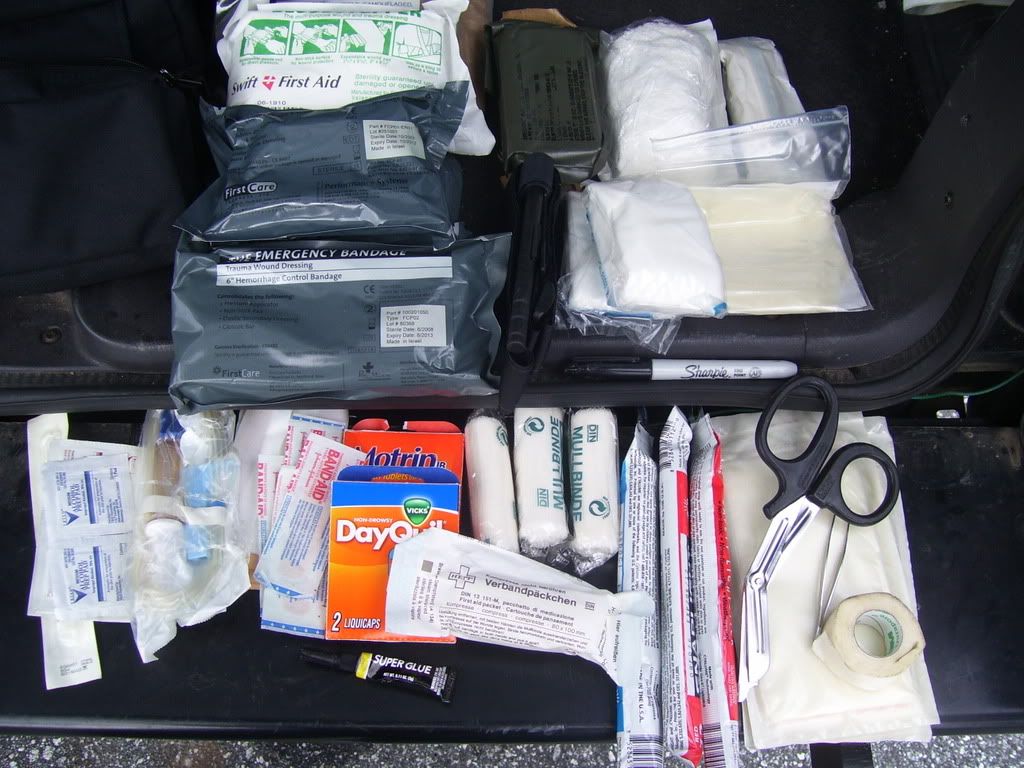


Sorry for the long, drawn out post, but medical readiness is a huge thing for me. I have seen a lot of bad things happen to guys close to me over the years, and they are never expected. When somebody is pouring blood in front of you is not the time to figure out what you need to do or what you should have had ready. It comes out of nowhere so you just have to be ready always, with the right gear and the right knowledge. |
|
Quoted:
any sort of granular hemostatic clotting agent is bad, as it can be swept by the wind into your eyes, or cause damage to veins and arteries through the heat it produces. Combat gauze and gaze based clotting agents are the new hotness. I would suggest checking the outdoors forum for any one of the bazillion threads on personal trauma kits. Here's my cut and paste response for these types of threads. I keep a basic bloodstopper kit on my plate carrier, and extra tourniquets all over. A larger CLS style aid bag is never far, there is one in every vehicle I am in both work and personal. My personal kit consists of: HSGI bleeder pouch trauma shears 4" israeli pressure dressing S-rolled gauze combat gauze additional pouch with SOFT-T tourniquet velcro tourniquet on belt extra CAT tourniquets on body armor, pants pocket, and pack I keep sterile gloves in another pouch as I use them a lot for non-medical reasons Your main priority should be to stop bleeding and get them or yourself to better care, be it a larger aid bag or an actual facility. This requires tourniquets, gauze, hemostatic dressings (combat gauze or celox wrap), and pressure dressings combined with both direct and indirect pressure. A larger CLS bag should carry everything else such as occlusive dressings, NPA's, SAM splints, kerlix or rolled gauze, water gel, durapore tape, tegaderm, chest seals such as hyfin or bolin seals, and extra tourniquets. Once you get the absolute necessities you worry about the small stuff like bandages, alcohol wipes, sterile gloves, stomach pads, etc. Needles for chest decompression are good, but you definitely need to take a class on how to use them. Avoid powdered hemostatic agents such as powdered celox as they can blow into your eyes or cause scarring to the veins and arteries due to the heat they generate when solidifying. Avoid hemcon products on ebay as they can kill people with shellfish allergies. Hemostatic gauze is the best thing going right now. From the looks of your first aid kit I would suggest that you do some research and try to figure out how to use this stuff if you don't already know. You can search for the army's TCCC/CLS courses, they are a quick and dirty guide for the average joe on how to save someone's life in trauma situations. Even learning seemingly simple things like where and how to apply tourniquets is extremely vital. The neosporin and band-aids aren't going to do shit in the event of a GSW or car accident, so its good you are looking into expanding your capabilities. Here are some open source references to immediate trauma care, and publications which can illustrate how to use some of these medical supplies and give you a better perspective on treating a GSW. http://www.ar15.com/lite/topic.html?b=10&f=20&t=22 I buy a lot of stuff through www.remotemedical.com, they have the best prices on everything aside from tourniquets. You can find CATs and SOFT-T's on ebay or amazon cheaper.I prefer the SOFT-T's in a bag or pouch because they are kinda bulky, and I mount the CATs all over the place externally, either affixed with elastic tie offs or BFG tourniquet now holders. I just priced out the basic essentials on www.remotemedical.com and it isn't too bad, and you can use whatever bag or container you can afford. If you are interested in more than the simple basics they do offer blowout packages. S-rolled gauze: $1.42 Bloodstopper gauze: $3.27 Kerlix: $1.18 CAT: $44 (both tourniquets can be found on ebay or amazon cheaper, currently $25 on amazon for the CAT) SOFT-T: $32 Israeli bandage 4": $7.85 Israeli bandage 6": $8.33 Tegaderm film: $1.25 My vehicle kits http://i107.photobucket.com/albums/m303/daemon734/stuff/100_0549.jpg http://i107.photobucket.com/albums/m303/daemon734/stuff/100_0551.jpg http://i107.photobucket.com/albums/m303/daemon734/stuff/DSCF1388.jpg http://i107.photobucket.com/albums/m303/daemon734/stuff/DSCF1390.jpg Sorry for the long, drawn out post, but medical readiness is a huge thing for me. I have seen a lot of bad things happen to guys close to me over the years, and they are never expected. When somebody is pouring blood in front of you is not the time to figure out what you need to do or what you should have had ready. It comes out of nowhere so you just have to be ready always, with the right gear and the right knowledge. Dont apologize i appreciate it alot!!! I believe in all around readiness , so i understand |
|
Quoted:
Quoted:
I would highly advise AGAINST quick clot, it does more damage than good. I'm trying to understand this statement. If someone is bleeding out, and you shove a clotting product in the wound and apply compression, how does it do harm? The clot can be washed out when they get to surgery. edit: found this on the quick clot website. Evidently they used to have an old formula of quick clot that caused chemical burns. But the new formula does not. Does it burn? NO. The first generation of the QuikClot granular product, made from non-hydrated zeolite, was discontinued in 2008 when the hemostatic gauze formulation based on kaolin was introduced. That earlier granular product could cause exothermic reactions if not used properly. Quik clot powder is what I am referring to, the old shit... my apologies for being vague, we are used to calling the quik clot gauze Combat Gauze. folks tend to shop buy buying older medical items that used to be used by the military, and I've seen alot of folks here that have the old powder. |
|
Quoted:
Quoted:
Quoted:
I would highly advise AGAINST quick clot, it does more damage than good. I'm trying to understand this statement. If someone is bleeding out, and you shove a clotting product in the wound and apply compression, how does it do harm? The clot can be washed out when they get to surgery. edit: found this on the quick clot website. Evidently they used to have an old formula of quick clot that caused chemical burns. But the new formula does not. Does it burn? NO. The first generation of the QuikClot granular product, made from non-hydrated zeolite, was discontinued in 2008 when the hemostatic gauze formulation based on kaolin was introduced. That earlier granular product could cause exothermic reactions if not used properly. Quik clot powder is what I am referring to, the old shit... my apologies for being vague, we are used to calling the quik clot gauze Combat Gauze. folks tend to shop buy buying older medical items that used to be used by the military, and I've seen alot of folks here that have the old powder. Good to know. Prior to this thread all I had ever seen was the gauze. I still like thrombin the best :) |
|
any sort of granular hemostatic clotting agent is bad, as it can be swept by the wind into your eyes, or cause damage to veins and arteries through the heat it produces. Combat gauze and gaze based clotting agents are the new hotness.
I would suggest checking the outdoors forum for any one of the bazillion threads on personal trauma kits. Here's my cut and paste response for these types of threads. I keep a basic bloodstopper kit on my plate carrier, and extra tourniquets all over. A larger CLS style aid bag is never far, there is one in every vehicle I am in both work and personal. My personal kit consists of: HSGI bleeder pouch trauma shears 4" israeli pressure dressing S-rolled gauze combat gauze additional pouch with SOFT-T tourniquet velcro tourniquet on belt extra CAT tourniquets on body armor, pants pocket, and pack I keep sterile gloves in another pouch as I use them a lot for non-medical reasons Your main priority should be to stop bleeding and get them or yourself to better care, be it a larger aid bag or an actual facility. This requires tourniquets, gauze, hemostatic dressings (combat gauze or celox wrap), and pressure dressings combined with both direct and indirect pressure. A larger CLS bag should carry everything else such as occlusive dressings, NPA's, SAM splints, kerlix or rolled gauze, water gel, durapore tape, tegaderm, chest seals such as hyfin or bolin seals, and extra tourniquets. Once you get the absolute necessities you worry about the small stuff like bandages, alcohol wipes, sterile gloves, stomach pads, etc. Needles for chest decompression are good, but you definitely need to take a class on how to use them. Avoid powdered hemostatic agents such as powdered celox as they can blow into your eyes or cause scarring to the veins and arteries due to the heat they generate when solidifying. Avoid hemcon products on ebay as they can kill people with shellfish allergies. Hemostatic gauze is the best thing going right now. From the looks of your first aid kit I would suggest that you do some research and try to figure out how to use this stuff if you don't already know. You can search for the army's TCCC/CLS courses, they are a quick and dirty guide for the average joe on how to save someone's life in trauma situations. Even learning seemingly simple things like where and how to apply tourniquets is extremely vital. The neosporin and band-aids aren't going to do shit in the event of a GSW or car accident, so its good you are looking into expanding your capabilities. Here are some open source references to immediate trauma care, and publications which can illustrate how to use some of these medical supplies and give you a better perspective on treating a GSW. http://www.ar15.com/lite/topic.html?b=10&f=20&t=22 I buy a lot of stuff through www.remotemedical.com, they have the best prices on everything aside from tourniquets. You can find CATs and SOFT-T's on ebay or amazon cheaper.I prefer the SOFT-T's in a bag or pouch because they are kinda bulky, and I mount the CATs all over the place externally, either affixed with elastic tie offs or BFG tourniquet now holders. I just priced out the basic essentials on www.remotemedical.com and it isn't too bad, and you can use whatever bag or container you can afford. If you are interested in more than the simple basics they do offer blowout packages. S-rolled gauze: $1.42 Bloodstopper gauze: $3.27 Kerlix: $1.18 CAT: $44 (both tourniquets can be found on ebay or amazon cheaper, currently $25 on amazon for the CAT) SOFT-T: $32 Israeli bandage 4": $7.85 Israeli bandage 6": $8.33 Tegaderm film: $1.25 My vehicle kits Sorry for the long, drawn out post, but medical readiness is a huge thing for me. I have seen a lot of bad things happen to guys close to me over the years, and they are never expected. When somebody is pouring blood in front of you is not the time to figure out what you need to do or what you should have had ready. It comes out of nowhere so you just have to be ready always, with the right gear and the right knowledge. I'm currently working in a Role II Medical Treatment Facility in Afghanistan, and have been a Medical Platoon Leader in the not so distant past (Army). The only thing I would add to the above for immediate trauma are a few generic tampons for GSWs. Nothing absorbs blood pouring from a hole better As far as doing a Needle-Chest Decompression (for the cllapsed lung), I wouldn't worry about it until you get the training. You're better off sealing the wounds and stopping the bleeding, then moving to a medical facility. Even if you can do a decompression, if there is not a medical facility available within a few hours (max), well, you're probably just prolonging the suffering (IMO). Good luck to you in the Marines, may the interservice jokes be plentiful!
|