


|
Quoted:
It's been a while since I asked this so I'll throw it out again. How do I resurface this and check for square? Can I just 220 palm sand it? The top is all sticky and dirty. Drinks, lunches, glue ups, and so on. <a href="http://s868.photobucket.com/user/Timcohydronics/media/Mobile%20Uploads/889DBB55-E446-4C36-B6FA-4A618AB05370_zpsznxh8bcc.jpg.html" target="_blank">http://i868.photobucket.com/albums/ab250/Timcohydronics/Mobile%20Uploads/889DBB55-E446-4C36-B6FA-4A618AB05370_zpsznxh8bcc.jpg</a> I've done just that, then applied auto wax to the top to seal it. Bessemeyer fence? |
|
Take a razor blade and scrape it down....
Then wet sand with 220 or above above in light oil...like liquid wrench. Wipe it down really good, then apply a good coat of wax (NOT auto wax) use a paste finishing wax. http://www.essentialhardware.com/product_detail.php?pid=157136&gclid=CI_el9ORwLwCFYeEfgodYRUAag |

|
Quoted:
This, plus wear liquid proof gloves, acetone will really mess with your hands. As others have stated a good paste wax to protect it. This what I prefer, should be able to find it in any supermarket. http://imageshack.com/a/img11/9468/p1190483dt.jpg Quoted:
Quoted:
steel wool and acetone, http://imageshack.com/a/img11/9468/p1190483dt.jpg This Posted Via AR15.Com Mobile |
|
I use Boeshield on my table saw top, and orher cast iron tops.
Instead of WD-40 use some other solvent to clean up the sticky stuff only because it will probably be cheaper. I have used scotchbrite pads when I get some rust, and if its a really agrpgressive spot use a briteboy eraser to clean out that spot. Then wipe it down and apply Boeshield. It works pretty good, my shop is not heated unless I am working in there. |
|
Quoted:
My Dad taught me to work with wood and he never used either. What do you use them for? Quoted:
Quoted:
Am I looking for a bright spotless look, or super smooth with stains / cloudy areas? Don't mind the looks, just want smooth. Do you guys prefer biscuits or dowels? My Dad taught me to work with wood and he never used either. What do you use them for? Edge-joining two pieces of wood. |
|
Quoted:
Am I looking for a bright spotless look, or super smooth with stains / cloudy areas? Don't mind the looks, just want smooth. Do you guys prefer biscuits or dowels? Clean, shiny and smooth if you're going to sell it, but just smooth is plenty fine otherwise. And biscuits over dowels any day for me. |
|
Quoted:
My Dad taught me to work with wood and he never used either. What do you use them for? Quoted:
Quoted:
Am I looking for a bright spotless look, or super smooth with stains / cloudy areas? Don't mind the looks, just want smooth. Do you guys prefer biscuits or dowels? My Dad taught me to work with wood and he never used either. What do you use them for? Joining wood! Making new cabinet faces and doors. May still order doors and make the new face. I'm a beginner. Lots more welding time than wood. |
|
Quoted:
Quoted: Am I looking for a bright spotless look, or super smooth with stains / cloudy areas? Don't mind the looks, just want smooth. Do you guys prefer biscuits or dowels? hand cut dovetails...duh and nice farm/food sticker... Mom was a corn farm girl from Iowa. All her side were, and still own their family farms. Is it a mega-left thing? Got it at farmers market years back. Reminds me of mom. |
|
Quoted:
Aren't any of you guys suggesting oils worried about staining lighter colored soft woods like Maple. If any gets in teh wood, finish won't take You can use acetone to evac oils from the surface of a wood. But I wouldn't suggest oiling a tablesaw surface. Wax only, imo. |
|
Quoted:
Joining wood! Making new cabinet faces and doors. May still order doors and make the new face. I'm a beginner. Lots more welding time than wood. Quoted:
Quoted:
Quoted:
Am I looking for a bright spotless look, or super smooth with stains / cloudy areas? Don't mind the looks, just want smooth. Do you guys prefer biscuits or dowels? My Dad taught me to work with wood and he never used either. What do you use them for? Joining wood! Making new cabinet faces and doors. May still order doors and make the new face. I'm a beginner. Lots more welding time than wood. I suppose . . . I never really got into the cabinet door side of things with him, he started that after I had moved out. Cabinet faces . . . no dowels or biscuit. Not certain what to call what he does (not a technical woodworker, am I). Understand how to do it, but the words to explain it aren't there. |
|
Quoted: This I wouldn't use a power tool, the potential to dish the surface is too great. Quoted: Quoted: WD40 and fine steelwool. Apply butchers wax when finished. This I wouldn't use a power tool, the potential to dish the surface is too great. You can get scotchbrite belts for belt sanders. Armed with such a device you could strip the rust off any tool's table in a few minutes and would not do any more harm to the flatness of the table than the rust itself did. |
|
Quoted:
Am I looking for a bright spotless look, or super smooth with stains / cloudy areas? Don't mind the looks, just want smooth. Do you guys prefer biscuits or dowels? Dominoes. 
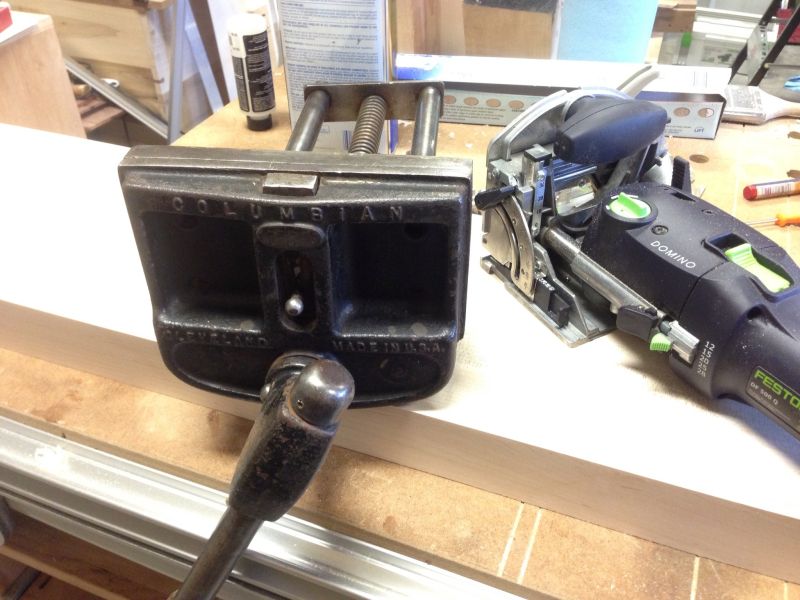
Easiest way to decide between biscuits and dowels is to remember that biscuits are for alignment and don't add any meaningful strength to the joint, whereas dowels are for strength. Dowels can be used for alignment, but biscuits are faster if you don't need the added strength of a dowel. |
|
Quoted:
I've used evapo-rust to convert. Soak paper towel in evapo rust and lay it on in strips. Cover with plastic wrap to keep from evaporating. Let it sit for a couple of hours, pull the towels, wipe it down vigorously, rinse, dry and wax. Easiest way by far. If you use Johnson's Paste Wax (big yellow can), it smells fucking horrible from the solvents flashing off. 
|
|
Random-orbital with fine hook-and-loop Scotchbrite pads and a little laquer-thinner. Paste-wax for protection, and check surfaces with a light-source, straight-edge, and feeler-gauges, if needed.
I would not scrape the glue and other table-top debris with anything even remotely sharp/edged to avoid gouging the surface. |
|
Quoted:
This, plus wear liquid proof gloves, acetone will really mess with your hands. As others have stated a good paste wax to protect it. This what I prefer, should be able to find it in any supermarket. http://imageshack.com/a/img11/9468/p1190483dt.jpg Quoted:
Quoted:
steel wool and acetone, http://imageshack.com/a/img11/9468/p1190483dt.jpg Johnsons wax!!!! clean with windex and rag, sandpaper 200+ or razor blade heavy stuff off. |

|
Quoted:
Hand sand it with a block then wax it with a non-silicone paste wax. Check for flatness with a level and a bright light behind it. Don't forget to clean and wax the fence too 
This dont use anything silicone based. After you sand it wipe it down with lacquer thinner. Then apply wax. |
|
Everyones mentioned the wax finish, but I just want to emphasize what a few have said-NO silicone in your wax. It's rub into the wood and won't take a finish.
Did I ever tell you guys about the time my wife laid a wet comforter over my jointer to "dry better"??? You can imagine what the surfaces looked like then. Fortunately, I caught it early on... |
|
Quoted:
Everyones mentioned the wax finish, but I just want to emphasize what a few have said-NO silicone in your wax. It's rub into the wood and won't take a finish. Did I ever tell you guys about the time my wife laid a wet comforter over my jointer to "dry better"??? You can imagine what the surfaces looked like then. Fortunately, I caught it early on... Eh, the silicone thing is over blown. The first time you get the saw good and dusty will take care of any finishing problems the silicone might cause. |
|
If you have a welder in the background, then you probably have a right angle grinder. There is an attachment, probably made by 3M, that threads right onto a right angle grinder. The face of it is one half of the velcro. Then scotchbrite discs have the other half of the velcro on their backs.
It looks like this: 
And dayummmnnn! Does it work fast and awesome. 
I have used Boeshield T-9 before: 
But I would swear the way it hazes up first and then you have to buff it off, it might as well be this: 
Just without the lemon scent. I had asked another guy on the cast boolits forum, who is known for his machine restorations. He swears by Johnson Paste Wax . |