


Posted: 6/5/2016 6:46:01 PM EDT
| I have a 5" R1 1911 with a factory installed 16# recoil spring per manufactures data. I have around 500 rounds through it and have noticed the recoil is nearly unmanageable. By comparison I've shot other 5" steel 1911's, and even had a super carry ultra plus Kimber (alloy frame!) that was not near as much felt recoil. This seems about like the recoil from a kahr pm45 small polymer pistol. The ammo I've used is all 230 grain FMJ - Remington UMC, and PMC. I've ordered a 18.5# spring from Wilson combat but after reading more, I'm concerned that even though this may reduce the rearward force it might increase the forward force to the point of causing damage. I'm looking for any suggestions to soften this thing up a little bit to enjoy shooting it more. Thanks |
|
Forward travel energy is eaten up/lessened by chambering a fresh rd.
Rearward travel has nothing other than the mainspring (hammer cocking) & recoil spring to lessen the energy. I have in the past run a 20lb recoil spring due to that's all the gun smith had at the time I needed one. Didn't hurt a thing. Of course, I also don't let the slide slam home on an empty chamber either. But an 18lb spring should be ok to slow the slide enough, IMO. If not, look to your mainspring, make sure it's within specs. My .o2 |
| The 18.5# is a cheap way to figure out if it solves the problem for you. I've run 18.5# springs for a while now, and only recently did I read that 16# is "the way to go" with standard pressure ammunition. Never had any problems with it, and although I have read that an 18.5# may increase felt recoil, my 1911 has always felt like it recoiled significantly less than other comparable guns with 16# stock springs. |
|
Based on a personal recommendation from Hilton Yam, I'm using an 18.5 lb recoil spring in my E Series 1911TA (which has a 23lb mainspring) while shooting cheap FMJ range ammunition almost exclusively with 100% reliability.
The gun also ran perfectly well with a 16 and 17.5 lb recoil spring though. A heavier recoil spring can aid in getting a problematic gun running because it will strip rounds from the magazine and chamber them more forcefully, but it can also cause failures to extract or eject in some pistols and it will increase muzzle dip when the gun returns to battery. Springs are cheap so try one in your pistol to find out whether or not you believe it makes your gun more pleasant to shoot. But the recoil spring comes into play only after the barrel unlocks from the frame and slide after the recoil has already been generated. |
|
Quoted:
install a small radius firing pin block. Check your grip you want the gun as low as possible in the hand. This.... In my experience people who are experiencing what they call heavy recoil from a 1911 are not gripping the pistol properly and the pistol is riding in the hand instead of you running the pistol as high as possible. I have also noticed that commonly the support hand is not applying pressure to the left side of the pistol grip allowing recoil to follow least path of resistence. Increasing spring tension may not solve the problem for you I only increase spring tension if the frame is getting battered or in Al frame pistols. |
|
Quoted: This.... In my experience people who are experiencing what they call heavy recoil from a 1911 are not gripping the pistol properly and the pistol is riding in the hand instead of you running the pistol as high as possible. I have also noticed that commonly the support hand is not applying pressure to the left side of the pistol grip allowing recoil to follow least path of resistence. Increasing spring tension may not solve the problem for you I only increase spring tension if the frame is getting battered or in Al frame pistols. Quoted: Quoted: install a small radius firing pin block. Check your grip you want the gun as low as possible in the hand. This.... In my experience people who are experiencing what they call heavy recoil from a 1911 are not gripping the pistol properly and the pistol is riding in the hand instead of you running the pistol as high as possible. I have also noticed that commonly the support hand is not applying pressure to the left side of the pistol grip allowing recoil to follow least path of resistence. Increasing spring tension may not solve the problem for you I only increase spring tension if the frame is getting battered or in Al frame pistols. Bingo ...... |
|
Quoted:
Bingo ...... Quoted:
Quoted:
Quoted:
install a small radius firing pin block. Check your grip you want the gun as low as possible in the hand. This.... In my experience people who are experiencing what they call heavy recoil from a 1911 are not gripping the pistol properly and the pistol is riding in the hand instead of you running the pistol as high as possible. I have also noticed that commonly the support hand is not applying pressure to the left side of the pistol grip allowing recoil to follow least path of resistence. Increasing spring tension may not solve the problem for you I only increase spring tension if the frame is getting battered or in Al frame pistols. Bingo ...... But OP already said he shoots other 1911s and doesn't experience this recoil, which would point to a localized issue and not a systemic one like poor grip/posture. |
|
"standard" spring weights (recoil / main) are 16 / 23 lbs, although the 1911 is pretty forgiving of variations of a few pounds either way. My experience is that small variations in spring weights don't do much re. felt recoil.
I would look at the hand / frame interface, particularly the grip safety, and compare those to known comfy 1911s. A little difference in curve or radius can batter some folk's hands while being perfectly comfortable for others. |
|
Quoted:
Is it a mil spec style? The guns with "high rise" beavertail grip safeties are more comfortable to shoot and shoot flatter than tang safety guns. Honestly, I've never noticed a difference in the recoil between a GI grip safety and a high rise beavertail in regards to feltt recoil. Hammer bitr, yes. Felt recoil no. |
|
Quoted:
The slide has moved around 0.1 inch or so. Felt recoil starts as soon as the bullet begins moving in the barrel. Quoted:
Quoted:
The bullet has already left the barrel before the barrel is unlocked from the slide, therefore, full recoil has already been generated. The slide has moved around 0.1 inch or so. Felt recoil starts as soon as the bullet begins moving in the barrel. This is the sequence that actually occurs when a 1911 is fired. http://www.m1911.org/locking.htm |
|
Quoted:
This is the sequence that actually occurs when a 1911 is fired. http://www.m1911.org/locking.htm Quoted:
Quoted:
Quoted:
The bullet has already left the barrel before the barrel is unlocked from the slide, therefore, full recoil has already been generated. The slide has moved around 0.1 inch or so. Felt recoil starts as soon as the bullet begins moving in the barrel. This is the sequence that actually occurs when a 1911 is fired. http://www.m1911.org/locking.htm And in high frame rate movies you can see the slide start to move rearward before the bullet exits the barrel. Every time. You can make all the drawings you want. Watch a high frame rate movie. |
|
Quoted:
And in high frame rate movies you can see the slide start to move rearward before the bullet exits the barrel. Every time. You can make all the drawings you want. Watch a high frame rate movie. Quoted:
Quoted:
Quoted:
Quoted:
The bullet has already left the barrel before the barrel is unlocked from the slide, therefore, full recoil has already been generated. The slide has moved around 0.1 inch or so. Felt recoil starts as soon as the bullet begins moving in the barrel. This is the sequence that actually occurs when a 1911 is fired. http://www.m1911.org/locking.htm And in high frame rate movies you can see the slide start to move rearward before the bullet exits the barrel. Every time. You can make all the drawings you want. Watch a high frame rate movie. Only in videos whose frame rates are inadequately high to show what's actually going on during the firing sequence. Inadequate frame rates introduce recording artifacts that misrepresent the true sequence of events. An incorrectly built pistol may unlock early as well. 73,000 frames per second. 
https://m.youtube.com/watch?v=7y9apnbI6GA |
|
Quoted:
Only in videos whose frame rates are inadequately high to show what's actually going on during the firing sequence. Inadequate frame rates introduce recording artifacts that misrepresent the true sequence of events. An incorrectly built pistol may unlock early as well. 73,000 frames per second.
https://m.youtube.com/watch?v=7y9apnbI6GA Quoted:
Quoted:
Quoted:
Quoted:
Quoted:
The bullet has already left the barrel before the barrel is unlocked from the slide, therefore, full recoil has already been generated. The slide has moved around 0.1 inch or so. Felt recoil starts as soon as the bullet begins moving in the barrel. This is the sequence that actually occurs when a 1911 is fired. http://www.m1911.org/locking.htm And in high frame rate movies you can see the slide start to move rearward before the bullet exits the barrel. Every time. You can make all the drawings you want. Watch a high frame rate movie. Only in videos whose frame rates are inadequately high to show what's actually going on during the firing sequence. Inadequate frame rates introduce recording artifacts that misrepresent the true sequence of events. An incorrectly built pistol may unlock early as well. 73,000 frames per second.
https://m.youtube.com/watch?v=7y9apnbI6GA Moving and unlocking are not the same thing. A 1911 slide can move a fair distance rearward before unlocking. And the slide did move in that video. Maybe not even a .100" but they generally do move rearward some. It did not UNLOCK. Not unusual for locked breech semi auto. 

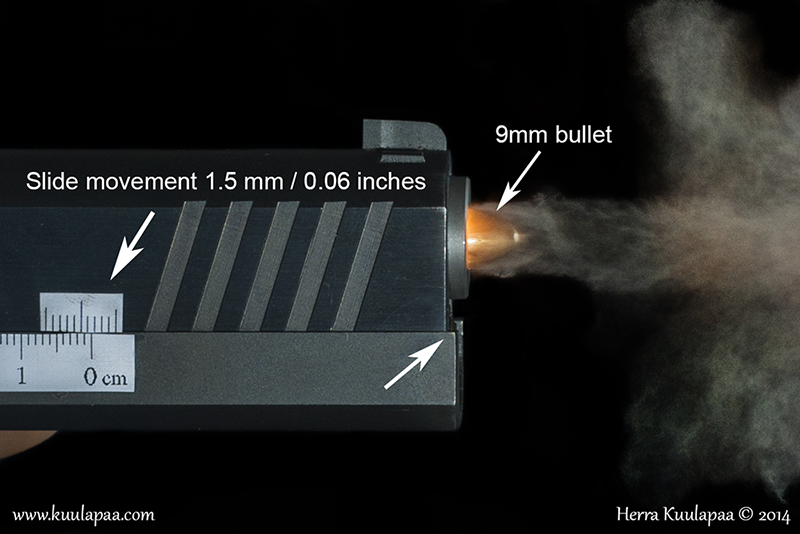
This video at 1m07sec also shows the slide clearly moving. Also looks to be an STI pistol. https://www.youtube.com/watch?v=G0VjdI_S_HM&t=1m07s |
|
Quoted:
Quoted: The bullet has already left the barrel before the barrel is unlocked from the slide, therefore, full recoil has already been generated. Is anyone else old enough to remember "Froggy the Gremlin". Because this exchange reminds me of Froggy the Gremlin.  Recoil energy that is transferred to the slide is what moves the slide rearward and compresses the recoil spring after all. Dissipating this energy over time can lower perceived recoil (not only rearward movement but forward movement, all long after the bullet is gone). A heavier spring may not have a positive effect on felt recoil because it can speed up the cycle time. It may go rearward slower (very slightly in terms of actual time, but it is all relative and will be soaking up more), but will come forward faster. It all depends on a lot of factors. OP might also want to consider a reduced power weight recoil spring also, like a 14#, or even another 16# that didn't come from Remington. I think Wolff still sells kits too? Buffer won't hurt either, at least for a range toy. http://www.shootingtimes.com/gunsmithing/recoil-spring-rate-affects-timing/ Because of the name that is a bit of a misnomer, "recoil spring", people do not realize that the main purpose of the spring (in a locked breech design) is to return the slide to battery. The above link shows an 8% difference in time when it comes to the rearward movement of a 1911 slide between a 12 and 20 pound spring (12 to 20 is a 66% increase). But the forward movement is often more noticeable. As for the concern about damage the OP has, the problems with higher weight springs is they apply more force to places that were not designed to take it (barrel feet, slide stop pin and hole..), and reduce it in places that were (slide and frame abutments.. why it is possible to fire a 1911 repeatedly with out a recoil spring at all, besides the locked breech design). You can have damage from a stronger spring in the long term. It is going to hit those components harder.. components not made to take a hit. Pin hole isn't hardened very much at all and can wear with a standard spring let alone a higher weight one. The pin is hardened and is more prone to breaking under greater force. Same with barrel feet. Basically it will stress some parts more, but you may never see an issue.Not that much of a difference between the two to begin with. ETA: With 500 rounds out of it I would tear it down and check for unusual wear too, like barrel flanging mentioned, peening etc. |
|
Quoted:...recoil is nearly unmanageable. ... no 5" steel 1911 should be " unmanageable " It's not a 454 casull 6lb. spring or 100lb spring, the 45ACP is a low pressure round without a lot of recoil. there is some muzzle flip, but we are not talking about large caliber magnums here. Tell us how you are holding the gun. can you post a pic, gripping your 1911 ? check these videos out... 
|
|
It would take almost no muscle tension in the arm to make the recoil seem excessive with most 230 grain ball loads.
You would have to barely be holding the weight of the pistol up. Very relaxed. You cannot alter your muscle tension fast enough to affect the recoil adequately. It happens much faster than the nerves in your arms can respond to alter the muscle tension after the hammer falls. It is faster than even a reflex (sensory nerve to spine and back to motor nerve without no conscious intervention). |