


[ARCHIVED THREAD] - Homemade uber-UPS system (pictures) (Page 1 of 3)
Posted: 7/18/2009 7:44:45 PM EDT
|
Updated with solar charger system
Watts UPS? So I came across 12 tons of gently used UPS batteries free for the taking. 
Yes since I wrote this I gave away all the batteries, very sorry. 
These guys sell for $400 each new and provide 135 amp hours worth of current or 1775 watt/hours worth of power each. My current UPS is stacked with 110 amp hour batteries a couple years old so I swapped those out for the new/bigger ones. The purpose of this thing is to provide power for my amateur radio gear and to provide power for my freezer. My freezer draws 2.4 Kw a day so the UPS will run it for 6 days. 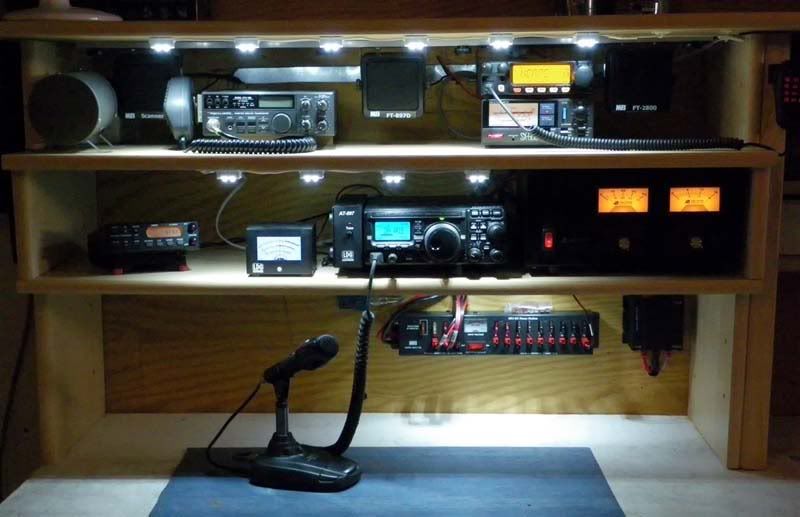
These batteries weight about 100 pounds each which is serious heavy so I went with mason blocks and 2x6" lumber to make a shelf frame. It worked out that three batteries and the bricks wedge in tightly between the side of my garage and a structural support so it's supported on three sides pretty well. When I'm finished two 2x6" boards seal the front of the shelves up. There's a piece of lumber along the back to prevent anything from dropping down and on top of the batteries. Gun safe just to the left of the picture is bolted to the floor and wall studs. 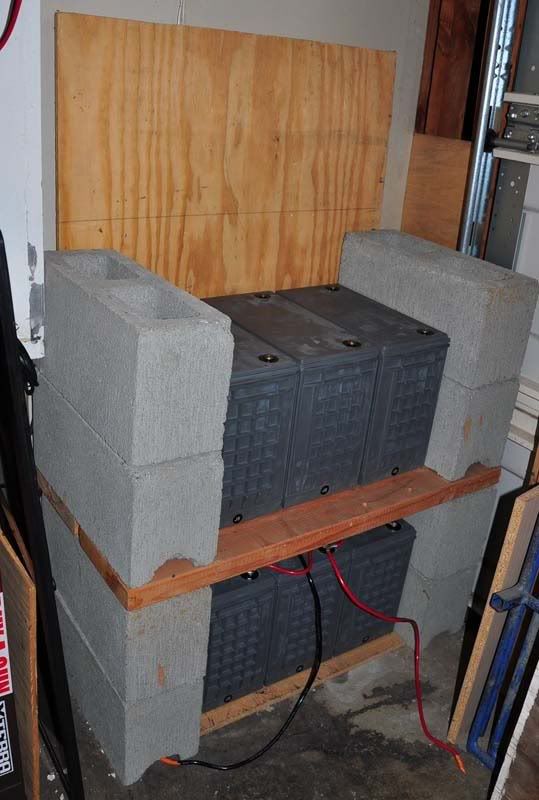
The batteries are designed to lock into each other tightly when set side-by-side. This is bad heat-wise but good earthquake wise. 
I bought 8 gauge wire which allows for a conservative 70 amps worth of current in free air. I kept the wires short enough so that they couldn't possibly reach between posts. I used a stubby ratchet wrench for the same reason. 
Crimps were done with the matching tool. If not crimped correctly the connectors can overheat and cause problems. 
I kept all wire ends taped together for safety until they're put into place on the distribution panel. Letting current sources of this magnitude connect together can cause explosions. I worked with high voltage/high current power for a living in the USN and this stuff is serious dangerous. I wore safety glasses at all time. Go slow! 
Here's the middle layer of the system ready to be closed up by the top layer. 
Once done a panel gets mounted on the front to take care of the inputs and outputs. I used a 4-way distribution block to input three banks of the batteries and the forth fuse is an output fuse that feeds my DC loads. The distribution boxes are hooked up "backwards" so that the big 4-gauge input is used for an output to the DC-to-AC inverter. 
The 4-gauge cable is rated conservatively for 140 amps of current for 1820 watts and should support the inverters 2 Kw if I ever came up with an AC load that big. 
Here's a close up of the fuse box - three of the fuses send power up to the inverter and the fourth takes power down and out to the ham radio gear. Holes cut into the wood organize the cables. There's holes cut in the shelf's 2x6" to organize the cables too. There's a bit of gap in the back and plenty in the front to allow for ventilation. More would be better. 
The panel allows for two different charging sources. On the left is a 7A charger that runs off of good old cheap AC power. Upgraded to a 15A AC charger. Next to it is a 7A solar charger waiting for 90 watts worth of solar cell ... I only have a 15 watt panel. I really need a bigger 300 w solar charger and $3000 worth of panels to match. Both chargers are programmed to match the absorbed glass mat batteries of the UPS. Mis-matching chargers can prevent the bank from reaching it's full potential. 
The AC inverter provides three outlets which I'll run across the house with extension cords. 
So now I'm thinking on adding I did add a forth layer to bring the system up to 21 Kw. 
Updated with Solar system I finally finished the goal of adding a solar system to my UPS to collect some of that free energy raining down every day. I purchased a pair of 50 watt panels for $125 each (after federal income tax rebate) from a fine company called Sun Electric in Florida. 50 Watts is a good small size and is enough to power my DC freezer or operate my ham radio gear. Together the 100 watts worth of panel ought to gather about 450-550 watt/hours worth of power on a sunny winter day here and much more come summer time. Solar maps vary from the different sources I've found, I guess measurement is the best way to figure it out. I have seen maps that claim as high as 6 to 6.5 hours for this area. 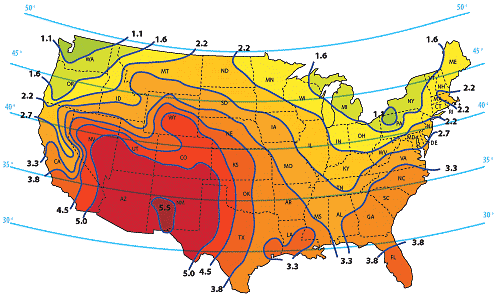
The 100 watts is small scale as some of my neighbors have 2500-3500 watts worth of panel. Now that's an investment! The panels arrived a couple of weeks after my credit card was charged and packed very well. Due to the nature of the panels most retailers will only ship in pairs or better. They pack the glass back to back with the aluminum frame to the outside of the box. No damage what so ever was noticed. 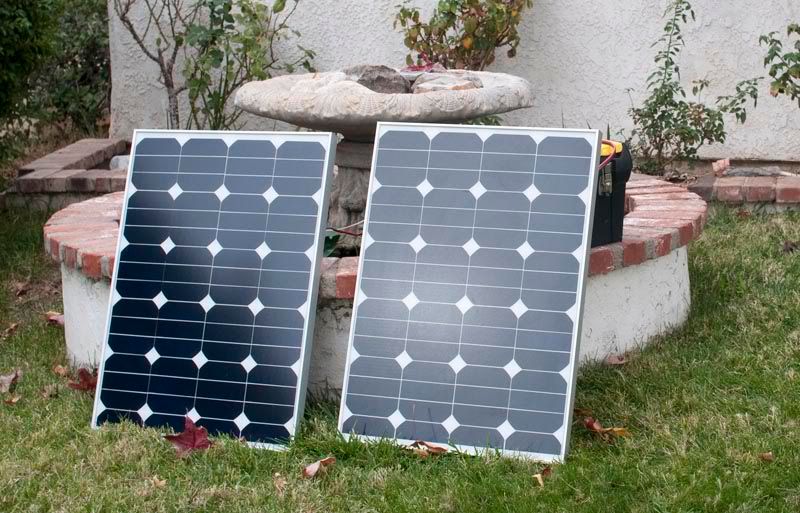
I put Anderson Powerpoles on everything and connected up a charge controller between the panels and a battery kit I have. The kit has an Optima YellowTop inside of the standard "Home Depot" box. Out of the front is a heavy gauge cable that plugs into a matching cable and via a relay into my SUV. There's a small and rugged LED light on the lid. There are two input/output ports that can feed in a charger and out to my ham radio gear. Both the low current and high current circuits are protected with separate fuses inside. 
Of course as luck would have it I tried the system out mid-day on the winter solstice on one of those 40-50 overcast days a year we get! My 50 watt panels were gathering about 4-5 watts each. The storm front rolls through tonight and tomorrow and we're looking forward to sunny Christmas day to remeasure the power output. I'm expecting to gather about 500 watt/hours a day from the system which for those without a bit of electrical understanding means I can burn 100 watts across 5 hours, 250 watts worth of load for 2 hours .... 
The sun came out today so I carried the system back out for testing. I connected a 60w spot light to the battery to drain it and then connected a 50w panel into the battery to charge it. I sloped the panel at about the pitch of my roof. Under full sunshine I measured about 54w which isn't bad at all with a +8% margin. 
|


|
Very cool! leave space between the batteries for cooling. Heat kills them. And (you probably already know this) make sure that your charger gives them an occasional equalization charge, it makes a difference in longevity.
properly cared for, those batteries can last ten years. Most UPSs treat them so badly that four years is often pushing it. |
|
You need a biggger smart charger. With all those amp hours it will take a while to charge.
charger/inverter |


|
Quoted:
How did you come across the battery give-away? I work at a television satellite broadcast facility that has two 250 Kw UPS systems. The batteries are swapped out every four years from the two systems so there's a "fresh" set of used batteries every couple of years. The UPS is tough on them as it's an in-line system with the load always drawing and the supply always providing. They've earned their retirement. |
|
Quoted:
Why dont you sell me a couple fo those batteries. like um say 3 of them Wonder what 300 pounds of battery costs to ship cross country? Every radio and television station in the nation (of any good size) is going to have big arrays of this type of battery that they go though every few years. We have to pay to have them shipped out and recycled so the boss is happy when they get taken away. |
|
Quoted:
Very cool! leave space between the batteries for cooling. Heat kills them. And (you probably already know this) make sure that your charger gives them an occasional equalization charge, it makes a difference in longevity. properly cared for, those batteries can last ten years. Most UPSs treat them so badly that four years is often pushing it. Yeah the heat.  I do have some 12 VDC fans to put on them but cooling them is impossible for me. Since my plan is to run the UPS slow and long I don't plan on heating things up too much. I do have some 12 VDC fans to put on them but cooling them is impossible for me. Since my plan is to run the UPS slow and long I don't plan on heating things up too much.
I do fire up the system from time-to-time putting an 800 watt AC heater on the inverter to give them a jolt. That 7A charger is just a top-off/float charger. My ham radio's battery back up provides 8A of charging while I'm using the radio and I have a 20A car battery charger to toss on there too. The recharge isn't something I'm completely happy with. Tomorrow I'm going to an open house at a neighbor with a solar array to see what the permit processes and costs are like. |
|
Quoted:
Very Nice, PM sent. Question, will your 15 watt panel keep the batteries charged enough ? No, 15 watts is merely a trickle charge. If just using the ham radio station it will give me months worth of use. If I were to get all 90 watts installed that would likely be more than enough. I do need to run some load calculations but I have measured my HF radio's draw and it's no where close to the 23A that the manual says is maximum. That might be CW or something but is sure isn't FM, AM, or SSB. |
|
Quoted:
Quoted:
Very Nice, PM sent. Question, will your 15 watt panel keep the batteries charged enough ? No, 15 watts is merely a trickle charge. If just using the ham radio station it will give me months worth of use. If I were to get all 90 watts installed that would likely be more than enough. I do need to run some load calculations but I have measured my HF radio's draw and it's no where close to the 23A that the manual says is maximum. That might be CW or something but is sure isn't FM, AM, or SSB. According to my manual, 8.5 amps max on high output. I usually run low power as our club W6LIE has several area repeaters. |
|
I worked for Exide in college and I can tell you that humping battery cells will bust your nuts.
Even shipped dry they are heavy as fuck. Those look like nicer sealed cells. Who makes them? Virtually all of our set-ups were lead acid jars. With the occasional gel-cell battery. |

|
Quoted:
I worked for Exide in college and I can tell you that humping battery cells will bust your nuts. Even shipped dry they are heavy as fuck. Those look like nicer sealed cells. Who makes them? Virtually all of our set-ups were lead acid jars. With the occasional gel-cell battery. They're made by Deka in Pennsylvania. My hands are killing me, the stress on lifting little 100 pound boxes of lead is tough on the fingers. 
|
|
Quoted:
I know they are expensive but look into a xantrex charger/inverter for that battery bank. There is one on the EE if I remember. I would buy a combination inverter/charger if I get a larger solar set-up. I really want 3 Kw worth of cells sitting on my roof but will likely get something less than that. |
|
Quoted:
Quoted:
I know they are expensive but look into a xantrex charger/inverter for that battery bank. There is one on the EE if I remember. I would buy a combination inverter/charger if when I get a larger solar set-up. I really want only need 3 Kw worth of cells sitting on my roof but will likely get something less much larger than that. Fixed it for ya because I know how this goes 
|
|
Remember that you have a serious Hydrogen generator cooking there.
They off-gas the most when they are charging. Keep them well ventilated and don't spark around them. Keep a 50# bag of sodium bicarbonate around for spills and leaks. The electrolyte looks like water but doesn't evaporate like water. Neutralize it with the baking soda and clean up with a good water flush. The sulphate residue is still corrosive. Keep the tops clean and dust free, a dirty jar allows a discharge path to develop between the poles. I'll also recommend using a corrosion inhibitor paste on the terminals. The stuff they sell for car batteries should work. We had gallons of an industrial brand, I don't remember the name, we just called it "red stuff". We also used a thicker grease that looked and smelled a lot like Cosmoline. The fumes will attack the terminal connections and the plates also wick up to the battery bolts. They'll corrode and get stuck in the cells. Use quality stainless steel hardware for this application. The ones you have look sealed but the routine is to check the gravity of each cell and it's voltage. One bad plate will ruin a cell and one bad cell will drag down the whole battery. This is as important as the total output of the battery. Replace the bad cells. The other trick is to disconnect the battery in the middle to halve the voltage when you are working on them. I got zapped by a 220/240 system once and it hurt. DC is a motherfucker. It was an interesting gig. I serviced batteries in the NSA, Pentagon and just about every other federal site in the Balt/DC area. We did the GE Electric Boat Division and a few UPS at the Navy Yard as well. The other half of the business is motive power, forklifts and other vehicles. Exide owns the mine car biz too. Many of the house brand automotive batteries sold are Exide manufactured and relabeled. Deka makes good product too. |
|
These are absorbed glass mat batteries so they can not spill and they can be mounted in any position. They're also pretty vibration proof too due to their internal construction. They do vent gases but only extremely small amounts - that said they are not to be mounted in a sealed box. My rack is designed to vent heat more than the charging gas. Living in the desert does also have the advantage in that we don't corrode/rust here either but I did have one terminal go blue on me. Also capacity is increased at higher temperatures - at 122 degrees F, battery capacity is about 12% higher.
I rarely run my batteries under a heavy load long enough to worry about recharging them with more than my trickle charger. I can charge my batteries based on temperature using my Astron VS-35M power supply between 13.5 volts at a chilly 70 degrees down to 13.1 at 95 degrees in heat of the summer. The output of the Astron runs into a Samlex BBM which sends 8A back into the battery bank while also supplying the ham station 17A. I use a Doc Wattson digital meter to measure loads and voltages. My boss managed to drop one and crack its case. He called the company and they recommended sealing the case with epoxy so he did and the thing is still running strong three years later. That much DC current is a son of a gun. Enough to vaporize a carelessly dropped screwdriver to be sure. As an ICmen and later an Electricians Mate in the USN I've worked on open electrical switchboards with 60 Hz and 400 Hz power but it was the DC boards to be careful around. The ship's gyro-compass and telephone system had a bank of huge 6 VDC batteries arranged to provide 48 VDC at the switch board. Setting up a UPS like this is not to be carelessly done by any means. AGM batteries have several advantages over both gelled and flooded, at about the same cost as gelled:
Since all the electrolyte (acid) is contained in the glass mats, they cannot spill, even if broken. This also means that since they are non-hazardous, the shipping costs are lower. In addition, since there is no liquid to freeze and expand, they are practically immune from freezing damage. Nearly all AGM batteries are "recombinant" - what that means is that the Oxygen and Hydrogen recombine INSIDE the battery. These use gas phase transfer of oxygen to the negative plates to recombine them back into water while charging and prevent the loss of water through electrolysis. The recombining is typically 99+% efficient, so almost no water is lost. The charging voltages are the same as for any standard battery - no need for any special adjustments or problems with incompatible chargers or charge controls. And, since the internal resistance is extremely low, there is almost no heating of the battery even under heavy charge and discharge currents. The Concorde (and most AGM) batteries have no charge or discharge current limits. AGM's have a very low self-discharge - from 1% to 3% per month is usual. This means that they can sit in storage for much longer periods without charging than standard batteries. The Concorde batteries can be almost fully recharged (95% or better) even after 30 days of being totally discharged. AGM's do not have any liquid to spill, and even under severe overcharge conditions hydrogen emission is far below the 4% max specified for aircraft and enclosed spaces. The plates in AGM's are tightly packed and rigidly mounted, and will withstand shock and vibration better than any standard battery. Even with all the advantages listed above, there is still a place for the standard flooded deep cycle battery. AGM's will cost 2 to 3 times as much as flooded batteries of the same capacity. In many installations, where the batteries are set in an area where you don't have to worry about fumes or leakage, a standard or industrial deep cycle is a better economic choice. AGM batteries main advantages are no maintenance, completely sealed against fumes, Hydrogen, or leakage, non-spilling even if they are broken, and can survive most freezes. Not everyone needs these features. http://www.windsun.com/Batteries/Battery_FAQ.htm#AGM,%20or%20Absorbed%20Glass%20Mat%20Batteries |

|
Quoted:
These are absorbed glass mat batteries so they can not spill and they can be mounted in any position. They're also pretty vibration proof too due to their internal construction. They do vent gases but only extremely small amounts - that said they are not to be mounted in a sealed box. My rack is designed to vent heat more than the charging gas. Living in the desert does also have the advantage in that we don't corrode/rust here either but I did have one terminal go blue on me. Also capacity is increased at higher temperatures - at 122 degrees F, battery capacity is about 12% higher. Capacity is higher at higher temp, but lifespan is much shorter. Not worth the tradeoff. |
|
Quoted:
Each bank of batteries has three hooked in parallel. He then has the lead to the fuses hooked to the center battery. I was just curious as to why he used the center battery. This pic http://i6.photobucket.com/albums/y215/paul1960/Amateur%20Radio/UPS/05UPS.jpg i thought thats what you were talking about. IDK why he has it like that, personal preference i guess. could be he wanted to keep everything equal. maybe he will share his thinking with us. |
|
Quoted:
Quoted:
Each bank of batteries has three hooked in parallel. He then has the lead to the fuses hooked to the center battery. I was just curious as to why he used the center battery. This pic http://i6.photobucket.com/albums/y215/paul1960/Amateur%20Radio/UPS/05UPS.jpg i thought thats what you were talking about. IDK why he has it like that, personal preference i guess. could be he wanted to keep everything equal. maybe he will share his thinking with us. In an ideal installation, the length of the battery cables would be the same for each battery to insure that that the batteries share the electrical load equally.. In Paul's installation this isn't quite true; the two "outer" batteries in each bank of three are electrically "farther" from the load than the center battery. I suspect that the cables that connect each three-battery bank to the inverter are different lengths as well. In Paul's case I don't think this deviation from the ideal matters. Since the total capacity of the battery bank is large relative to the load (I understand from a previous thread that the biggest thing he expects to run off this is a refrigerator) the current drawn from each individual battery is so low that a slight inbalance is irrelevant. |
|
Since the total capacity of the battery bank is large relative to the load (I understand from a previous thread that the biggest thing he expects to run off this is a refrigerator) the current drawn from each individual battery is so low that a slight inbalance is irrelevant.
Very true. Each level could run the entire load by itself. |
|
All good stuff, especially the safety pointers - fusing, disconnects, no wrench long enough to span terminals, and taping up and tying off leads when they are disconnected ! I've manged to briefly short a bank of 6 Optima yellow tops....not pretty.
Big batteries can dump insane amounts of current.... 
A buddy bridged his wedding ring between a car frame, a wrench and the hot side of the starter battery. It made the ring Red Hot in a fraction of a second. He had to cut it off with a pair of tin snips and then deal with 3rd degree burns. Ya'll be careful out there! |
|
Quoted:
All good stuff, especially the safety pointers - fusing, disconnects, no wrench long enough to span terminals, and taping up and tying off leads when they are disconnected ! I've manged to briefly short a bank of 6 Optima yellow tops....not pretty. Big batteries can dump insane amounts of current....
A buddy bridged his wedding ring between a car frame, a wrench and the hot side of the starter battery. It made the ring Red Hot in a fraction of a second. He had to cut it off with a pair of tin snips and then deal with 3rd degree burns. Ya'll be careful out there! One of the weirder installs I did for Exide was a big odd voltage battery at the National Bureau of Standards. It was in a blast room and the scientist types were doing high-speed photography of exploding wires. You know the little U.L. tag on your extension cords? Well these boys devise the standard for it. They were using the battery as a big current dump. The hardest part was drilling the blast wall for the charger installation. Two feet of concrete reinforced with quartz pebbles. We didn't have diamond bits and it took me about an hour a piece for each hole. Little scientist guy watched me sweating balls and leaning on the drill and came over to put in his two cents. "Do you see that door?", he said, pointing to a doorway cut into the wall. "Those guys used a diamond saw and it still took them two days." I was like, "Thanks for the input." 
|
|
Quoted:
All good stuff, especially the safety pointers - fusing, disconnects, no wrench long enough to span terminals, and taping up and tying off leads when they are disconnected ! I've manged to briefly short a bank of 6 Optima yellow tops....not pretty. Big batteries can dump insane amounts of current....
A buddy bridged his wedding ring between a car frame, a wrench and the hot side of the starter battery. It made the ring Red Hot in a fraction of a second. He had to cut it off with a pair of tin snips and then deal with 3rd degree burns. Ya'll be careful out there! We have battery banks at work for our UPS. When we work in close proximity around the batteries we put up thick carboard barriers since my boss is damn cheap not to buy us electrical insulating blankets. One of my co-workers learned the hard way and has a lot of profound respect not to come in contact on the main lugs of the rack. Let's just say it was the most "shock experience" of his life. All I can say to him "I told you so." |
|
Quoted:
Interesting they swap out after 4 years? I would like to get some. I need to check my solar people. I have 300VDC to 500VDC c oming off the panels, if I series them I could run one inverter when the panels are in the dark? If you have 300-500 VDC coming from your solar panels, you very likely have a grid tie system. Grid tie inverters WILL NOT produce electricity unless the grid power is present, to prevent backfeeding the grid. If you want, you might be able to reconfigure your strings and recable (much larger cable needed) to get a open circuit voltage of around 100VDC, and then there are several grid interactive inverters that charge and pull from batteries you can use. But the cabling is expensive, and one reason that grid tie solar uses such high string voltages. |
|
Another source for large batteries of this type is cell phone towers. They are required by law from what I understand to have a certain number of hours of "standby" time after the loss of grid power. Not long ago, when there was alot of consolidation in the cell phone industry, they were dumping towers left and right as they had more towers than they needed and those towers cost alot of money in monthly rental fees.....Much of the equipment in those towers was "surplus".
Lots of batteries out there if you know the right folks.......
|

|
If you have 300-500 VDC coming from your solar panels, you very likely have a grid tie system. Grid tie inverters WILL NOT produce electricity unless the grid power is present, to prevent backfeeding the grid.
If you want, you might be able to reconfigure your strings and recable (much larger cable needed) to get a open circuit voltage of around 100VDC, and then there are several grid interactive inverters that charge and pull from batteries you can use. But the cabling is expensive, and one reason that grid tie solar uses such high string voltages. Correct! If I did not do a grid tie in, NJ would not have given me a $42K Rebate. There are systems that will let you store in batteries and also run an aux genny |
|
Looks like I'm nearly done with the batteries this week. I've got two more people coming by from CalGuns and CalPrep forums and that's it! Looks like about 19,000 pounds worth of batteries given away to the survival and amateur radio folks. People came here from as far away as Bakersfield (about 6 hour drive) to get batteries. The biggest load went to a guy to took two loads of 36 batteries each.
My back is so happy that this is done with!
|