


Posted: 8/30/2015 9:34:20 PM EDT
| Somebody tell me about Mag-Loop antennas. I am somewhat intrigued. Looks like a great set up for times when you don't have anywhere to throw a wire. |
|
A member here gave me TWO of the MFJ's of which I gave one away to a new ham and the other is in my shed waiting to be put up. After the last round of big storms taking all my antennas down, it will be going up in a week or so after the roof is replaced.
He told me the loop works pretty well, but is very narrow banded which is typical of small loops and somewhat directional. I'll be installing this one on a roof tripod with a rotator. 
VK3YE on You Tube uses a small loop alot. I'll post a thread on it when I get it installed. |
|
Quoted:
A member here gave me TWO of the MFJ's of which I gave one away to a new ham and the other is in my shed waiting to be put up. After the last round of big storms taking all my antennas down, it will be going up in a week or so after the roof is replaced. He told me the loop works pretty well, but is very narrow banded which is typical of small loops and somewhat directional. I'll be installing this one on a roof tripod with a rotator.
VK3YE on You Tube uses a small loop alot. I'll post a thread on it when I get it installed. Hmm, I wonder who that might have been 
Mag loops are very interesting antennas, and if you're space limited are a pretty good solution. I'm going to get the one big negative out of the way first: because of how they work, you take a pretty big hit on TX. Mag loops break the "antenna reciprocity" rule, e.g. normally antennas receive and transmit the same. With mag loops, though, due to the high Q there are truly huge currents and the I^2R losses in real-world construction results in about an 8dB loss on transmit. So that works out to about 15W radiated for 100W input. Now let's talk about all the good stuff. They're super narrowband, so while they are touchy to tune, the good ones tune just fine (MFJ being one of the good ones in this respect), and this makes them like incredibly good preselectors. Stations that are a few KHz away literally have no impact on the front end of your rig, so it runs full out and is very sensitive. They're also very quiet. You're killing a lot of the noise, and they don't respond to localized RF noise (like power lines) nearly as much as conventional antennas. They're pretty small, the MFJ 40M-17M antenna KB7DX is describing is roughly the size of a box fan or hula hoop. And that "tiny" antenna gives basically the same full receive performance as a full-size dipole. When I did testing against my full 43' vertical with a remote tuner, the MFJ loop was on average 2dB weaker -- but that was mounted 18 inches off the ground. I don't doubt it'd probably signficantly outperfom a 43' vertical if the loop was installed 43' up. With all that said, my advice to people that aren't constrained by space is to spend the same money on a vertical and remote tuner -- it's more versatile. But if you're space constrained or have noise issues, a mag loop is a great antenna. There's a reason that in spite of the TX losses they're popular for QRP work (alex loop) because they're so portable, and even being 8dB down, are very efficient for a space-constrained portable antenna. |
|
Quoted:....
They're also very quiet. You're killing a lot of the noise, and they don't respond to localized RF noise (like power lines) nearly as much as conventional antennas..... Everything else stated above is fine except that the generalization "loops are quieter", or that they "don't respond to local noise", is often misunderstood and overstated! For example, a magnetic loop is often thought to respond only or largely to the magnetic field (hence it's name..) In fact, in the far field, the so-called mag loop responds to Electro Magnetic waves just like any antenna. In the near field, response is mostly to the Magnetic H-Field. And guess what - when you trudge through Maxwell's eqs or do careful measurement, you see that in an intermediate zone the "magnetic" loop responds most to the E-Field of the source! So, if those power lines are a wavelength or 2 away, and they happen to produce E field noise, then a mag loop is likely the worse choice. Similarly, if those power lines are less than a half wave away or so, and they happen to produce largely H field noise, then a mag loop is again likely the worse choice. IOW, a mag loop may or may not respond to localized noise better or worse than any other antenna - it all depends on the polarization of the noise source and antenna, it's E or H field characteristics, the pattern (directivity) of the antenna, and whether or not one is in the near, intermediate, or far field of antenna and noise source. Perhaps a given installation does in fact yield a better RX SNR. But also it is sometimes true that ops report that their mag loop antenna (or whatever it's type) is quieter simply because it's lossy and the noise level (as well as the signal!!!) is in fact lower, and henceforth ALL loops are thought to be quieter and yield better SNR in ALL situations. Anyway, mag loop can be a great solution, but some of what is attributed to them is web-lore! Good discussion of noise and quietness of general loops (which also applies to small mag loops) -------> http://www.eham.net/ehamforum/smf/index.php?topic=67026.0 . |
|
I live in a townhouse and my only option is indoor antennas. I picked up an AlexLoop fully expecting to have buyers remorse, but I was pleasantly surprised that it works pretty decently. If I had the space I would put up a wire antenna in a heartbeat and probably not touch the magloop again, but for my circumstances it does the job. I have a ton of RF noise from all my neighbors in close proximity. Like a solid S8-S9 on 40m-15m. However, I can turn my loop to null out a good portion of it, and can usually get the noise down to an S3-S4, not great by any means, but much better. I use the the Alexloop with my FT-817, and despite the small size of the antenna I've made a LOT of contacts with it. Between my LNR Precision 10/20/40, and the AlexLoop I've completed WAS SSB <5w. It took me a long time to get Alaska, but I made that QSO with the AlexLoop. I've also made quite a few DX contacts using 5w SSB into Europe and South America using the AlexLoop. Digital modes really squeeze the most out of the AlexLoop and I have nationwide coverage on JT-65 pretty much 24/7, and routinely make it across the Atlantic and Pacific. Just for fun I set up the AlexLoop in my in-laws basement and made a 40m SSB contact to a guy a few hundred miles away. Granted it wasn't a 5x9 armchair copy but the point is I still made it out using a rather lossy antenna, with 5 watts, 5ft below ground level, with a 2 story building over me. Here's a picture of my basement SSB QSO: 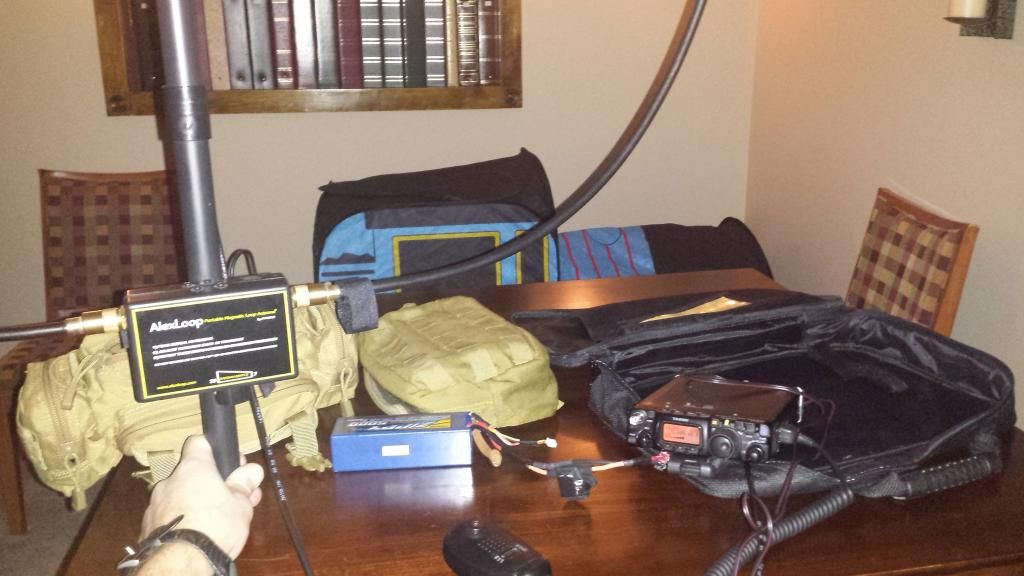 Here's a JT65 plot using the AlexLoop: 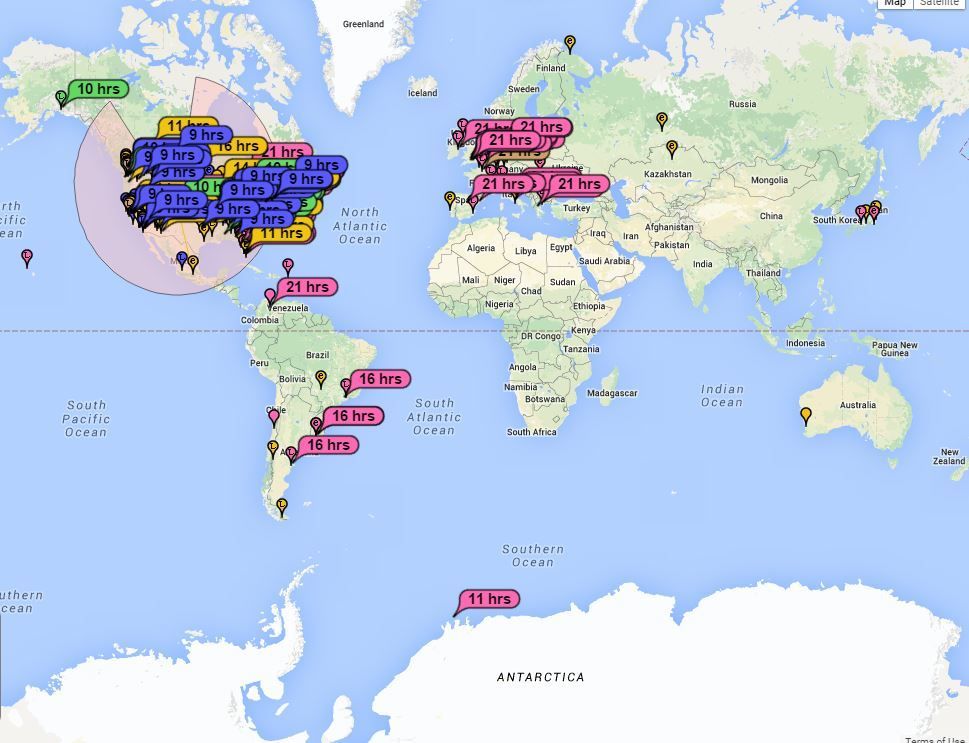 Here's a WSPR plot using the AlexLoop: 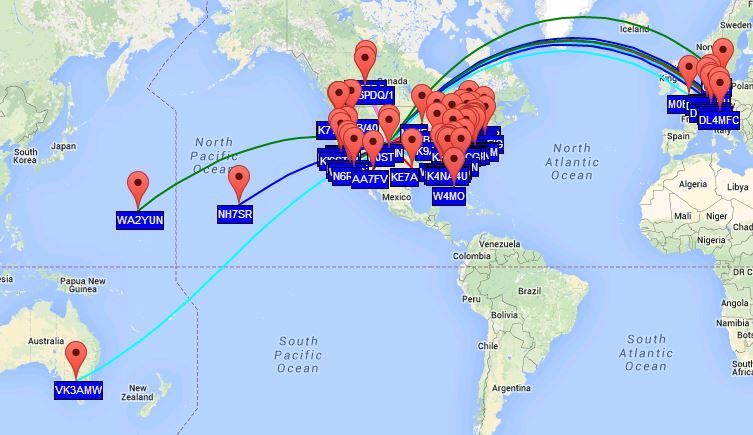 Typical park portable setup. Takes me about 3 minutes to set up. Just using a cheapo tripod from Amazon, with the head removed. 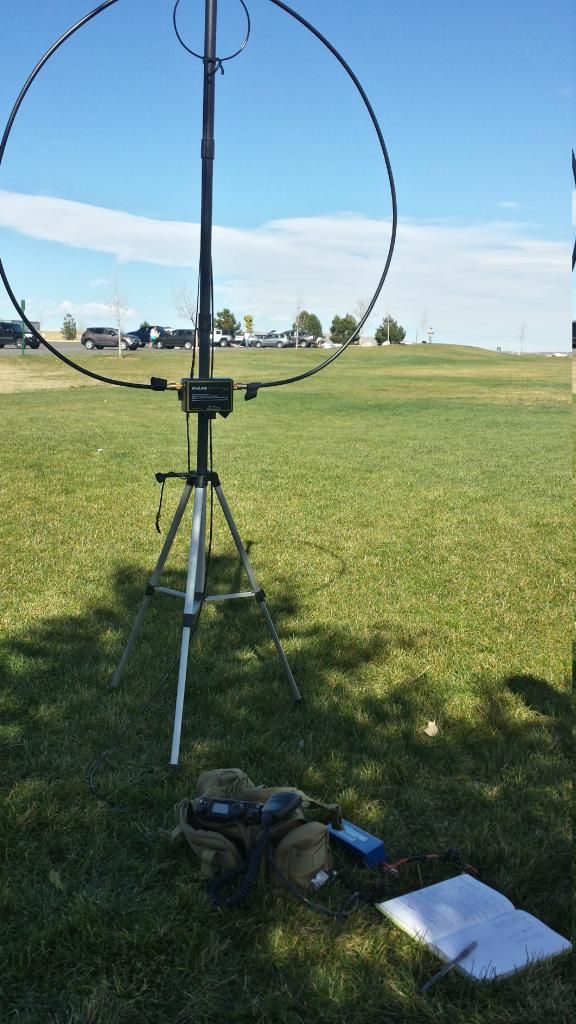 |
| Great information guys. Yall answered a lot of questions. My primary usage for the loop would be portable use. Due to physical challenges I need something that is pretty easy to deploy and fairly light weight. Sadly in most cases that means you have to give up some efficiency. I am really tempted to try one??? |
|
One ARFCOMer did an impromptu comparison between the Alex Loop and the Alpha Loop in this thread.
You should read: https://groups.yahoo.com/neo/groups/MagLoop/conversations/topics/3990 where a user has written, although it was before Alpha Antenna announced their system would have an SWR Indicator in it (which in my opinion places the Alpha Loop above all other loops available at this price point):
Alex Loop vs Alpha Loop - The facts you should know Additional testing is encouraged, and I am sure needed. I have eliminated the differences that appear obvious to me (bands covered, options included, etc.). I will do my best to compare seven common criteria; 1) Durability, 2) Losses, 3) Weight, 4) Bandwidth, 5) Efficiency, 6) Tuning, & 7) Price. 1) DURABILITY Alex Loop - Primarily constructed of Coax with PL259/SO239 connections & PVC with a variable air capacitor in a plastic box Alpha Loop - Primarily Annealed/Soft Solid Aluminum with stainless steel bolts/nuts, with variable air capacitors in UL-Listed Weatherproof Outdoor Electrical Box Winner - By a narrow margin, the Alpha Loop for their use of a UL-Listed Weatherproof Outdoor Electrical Box. 2) LOSSES Alex Loop - Losses occur when coax is used in the construction of a magnetic loop antenna because the braid of the coax has thousands of connection points. Additional losses occur at both of the PL259/SO239 where the coax attaches. Alpha Loop - Losses occur at 8 connection points. For the loop purest who wants no losses, buy the Continuous Loop from Alpha Antenna. Winner - I would like to see an end to end test done on the outer loop of each, measuring resistance and the like, so I will reserve judgement on the outcome till that is performed. 3) WEIGHT Both the Alpha Loop without tripod and the Alex Loop weigh just under 3 pounds. Winner - Tie 4) BANDWIDTH Alex Loop - All we know from the manufacturer is that this loop requires retuning when frequency is changed. Individual analysis from other sources indicates: 28.004 (SWR at 2.2) to 28.060 (SWR at 2.1) around 60 Khz of bandwidth. 21.020 (SWR at 2.0) to 21.070 (SWR at 1.7) around 50Khz of bandwidth 14.000 (SWR at 2.1) to 14.035 (SWR at 1.9) around 35Khz of bandwidth 10.110 (SWR at 1.8) to 10.125 (SWR at 1.9) around 15Khz of bandwidth 7.005 (SWR at 2.5) to 7.015 (SWR at 2.6) around 10Khz of bandwidth Alpha Loop - The manufacturer of the Alpha Loop (Alpha Antenna) is upfront with a scientific analysis from a RigExpert AA-54 antenna analyzer. Ref: http://alphaantenna.com/pdf/Alpha_Loop_Analysis.pdf "Unlike other magnetic loop antennas that require retuning because of narrow bandwidth, the Alpha Loop provides a generous bandwidth of approximately 35% of the 15 meter band, 85% on 17 meters, 20% on 20 meters, 100% on 30 meters, & 20% of the 40 meter band while maintaining an SWR of between 1.1:1 and 3:1. This is made possible because we do not use a coaxial shield or copper tube in the construction of the Alpha Loop Antenna. Rather, the Alpha Loop Antenna uses a specially selected aluminum alloy that has particular chemical properties to make it softer and have less resistance than 'rigid aluminum' tubing. The minimally resistive properties and physical dimensions help to optimize the bandwidth and effected radiated power of the antenna. Additionally, we use only Brass Bolts and Nuts at the connection points that feed the antenna as well as silver plated shield and gold plated pin connectors on the SO239 at the feed point of the antenna to further decrease the resistance throughout the whole antenna system." ~ Alpha Antenna Winner - Alpha Antenna 5) EFFICIENCY Comparing the Alpha Loop & Alex Loop I have spent much time inputting all of the variables into http://www.66pacific.com/calculators/small_tx_loop_calc.aspx for the bands that are safe to operate both the Alex and Alpha Loop on, and found why the Alpha Loop has more gain. The measurements from Alex for his loop are Length of Conductor (antenna "circumference") = 10.3 feet & Diameter of Conductor .32 inches. Here are the calculated efficencies for the Alex and Alpha Loop antenna's. Please not that the Alpha Loop's measurements are Length of Conductor = 9.92 feet & Diameter of Conductor = .477 Antenna efficiency - The Alpha Loop VS the Alex Loop From 7 to 7.3 MHz Alpha Loop; 8% - 9% Alex Loop; 6% - 7% From 10.1 to 10.150 MHz Alpha Loop: 23% - 23% Alex Loop: 18% - 18% From 14 to 14.350 MHz Alpha Loop: 48% - 50% Alex Loop: 41% - 43% From 18.068 to 18.168 MHz Alpha Loop: 69% - 70% Alex Loop: 63% - 63% From 21 to 21.450 MHz Alpha Loop: 79% - 80% Alex Loop: 74% - 76% An alarming find when I input Alex's measurements for his loop into http://www.66pacific.com/calculators/small_tx_loop_calc.aspx for 10 through 12 Meters occurred. On those frequencies a RED message appears that says: "To avoid self-resonance, the conductor length for a small transmitting loop antenna should be less than 1/4 wavelength." I now understand why the AlexLoop should not be used on 10 & 12 Meters, which is because exponential increases in resistance will occur on a small transmitting loop when self-resonance occurs, which can damage equipment. For more information on this, see the section titled "Inductance and self-resonance" here: http://www.antennex.com/preview/Dec03/Dec603/Loopantennas.htm 6) TUNING Bandwidth determines how often an antenna has to be retuned, so the Alpha Loop has a fair advantage over the Alex Loop from the start. When retuning is required, the 6:1 reduction drive in the Alpha Loop's MicroTune version makes it easy to declare the Winner - Alpha Loop. 7) PRICE Alex Loop (antenna only) $366 Delivered. Ref http://www.alexloop.com/buy.html Alpha Loop (Antenna Only) $295 when on sale and MSRP $349. Ref http://www.AmateurRadioStore.com Might want to look into the Alpha Loop as well. |
|
"Unlike other magnetic loop antennas that require retuning because of narrow bandwidth, the Alpha Loop provides a generous bandwidth of approximately 35% of the 15 meter band, 85% on 17 meters, 20% on 20 meters, 100% on 30 meters, & 20% of the 40 meter band while maintaining an SWR of between 1.1:1 and 3:1. ...... Rather, the Alpha Loop Antenna uses a specially selected aluminum alloy that has particular chemical properties to make it softer and have less resistance than 'rigid aluminum' tubing. The minimally resistive properties and physical dimensions help to optimize the bandwidth and effected radiated power.." "Special Aluminum"? with " minimally resistive properties and physical dimensions help to optimize the bandwidth..." Well, no - Minimall Resistance Increases Q, and Reduces bandwidth. A hallmark of a good high efficiency small antenna is how NARROW it's bandwidth is, The wide bandwidth data shown in the pdf is what you would expect from a LOSSY loop - So I'd be very skeptical of the marketing hype - the quote above sounds pretty darn fishy .... |
|
A floor microphone stand is both an inexpensive and strong way to support the AlexLoop. It's also height-adjustable.
http://www.amazon.com/Stage-MS7700B-Tripod-Microphone-Stand/dp/B0013V1BYY |
|
New question... how can I make one! They can't seriously be $400 worth of stuff...
|
|
Quoted:
New question... how can I make one! They can't seriously be $400 worth of stuff... Quoted:
New question... how can I make one! They can't seriously be $400 worth of stuff... I met Alex at the Dayton Hamfest and I think I ended up selling a couple to interested people who stopped by while we were chatting. |