


Posted: 5/7/2016 4:18:24 PM EDT
|
OK, I have the following "parts" and was wondering if they would be suitable for portable power. I bought one of these: http://www.amazon.com/DROK-Regulator-Converter-Transformers-Adjustable/dp/B00C4QVTNU/ref=sr_1_2?ie=UTF8&qid=1462651046&sr=8-2-spons&keywords=voltage+regulator&psc=1 ...and a little volt meter, and installed it in a radio shack project box. The regulator uses one of those little blue plastic trimmer pots to adjust the power output. I removed that from the board and installed a larger pot so it can be adjusted as needed. The adjustment range is very "touchy" and I suppose I could put in a switch and some resistors to allow different voltage ranges and smoother adjustment.   I have this 28W 18V solar panel powering it.  It does actually work...   And my storage battery.  I built this last year, but haven't really sat down to see if it will all work well together. I do have a "Battery Tender" charger that supposedly will work with these LiFe batteries (though they are made for lead/acid). I chose to use barrel connectors for power so that they will work with the solar panel and it's accessories. I can easily make up a little pigtail for power poles if need be. I also expect that the buck controller could get hot in the enclosed container, but I guess that depends on how much current I draw. I imagine it will do fine for charging tablets and AA batteries, but not sure how it will work with the LiFe battery. Your thoughts?
|
|
Quoted: For static use it seems fine. I'm in the midst of trying to put together a decent solar setup that I will use to charge my LiFePO4 RC batteries. Got everything but the panel. I like the idea of your homebrew regulator. Are you using an R/C style charger, or something else? One of these days I want to dig into the regulator a bit deeper and find the right resistor combination to limit the maximum output to 13.8V while still allowing the pot to adjust below that, then add a crowbar circuit to blow the fuse in case something goes wrong. That would allow me to use it to drive lower voltage chargers like the 10V charging base for my handheld, and not exceed 13.8V when connected to a radio. This panel does have an on board 5V USB charging output. |
|
FWIW I ran a 30 watt special event from Camp Perry back in 2012.
I supplied ALL of my power from a Harbor Freight set of solar panels. Ask BigOhio. Oh, yeah.Shooters Amateur Radio Club is getting ready to have another election for the position of 'Dictator For Life'. This is an annual elected position. (This is a paid political ad for re-electing Jupe.) I am still taking the position of Vice President as nobody is opposing me. This is likely because as Vice President I have done a good job of splitting up all the incoming hookers and blow evenly. Anyone that is a member and hasn't gotten their share of the hookers and blow please speak up and I will make sure you get your fair share. |
|
Quoted:
Are you using an R/C style charger, or something else? One of these days I want to dig into the regulator a bit deeper and find the right resistor combination to limit the maximum output to 13.8V while still allowing the pot to adjust below that, then add a crowbar circuit to blow the fuse in case something goes wrong. That would allow me to use it to drive lower voltage chargers like the 10V charging base for my handheld, and not exceed 13.8V when connected to a radio. This panel does have an on board 5V USB charging output. Quoted:
Quoted:
For static use it seems fine. I'm in the midst of trying to put together a decent solar setup that I will use to charge my LiFePO4 RC batteries. Got everything but the panel. I like the idea of your homebrew regulator. Are you using an R/C style charger, or something else? One of these days I want to dig into the regulator a bit deeper and find the right resistor combination to limit the maximum output to 13.8V while still allowing the pot to adjust below that, then add a crowbar circuit to blow the fuse in case something goes wrong. That would allow me to use it to drive lower voltage chargers like the 10V charging base for my handheld, and not exceed 13.8V when connected to a radio. This panel does have an on board 5V USB charging output. Yeah for my portable kit I'm using a Turnigy B4 charger which is ultralight/compact. I figure it should charge 4S lipo well enough. I just gotta save up for a decent solar system to plug it into. I was actually looking at the system you have IIRC a month or two ago. |
|
Quoted: Yeah for my portable kit I'm using a Turnigy B4 charger which is ultralight/compact. I figure it should charge 4S lipo well enough. I just gotta save up for a decent solar system to plug it into. I was actually looking at the system you have IIRC a month or two ago. Quoted: Quoted: Quoted: For static use it seems fine. I'm in the midst of trying to put together a decent solar setup that I will use to charge my LiFePO4 RC batteries. Got everything but the panel. I like the idea of your homebrew regulator. Are you using an R/C style charger, or something else? One of these days I want to dig into the regulator a bit deeper and find the right resistor combination to limit the maximum output to 13.8V while still allowing the pot to adjust below that, then add a crowbar circuit to blow the fuse in case something goes wrong. That would allow me to use it to drive lower voltage chargers like the 10V charging base for my handheld, and not exceed 13.8V when connected to a radio. This panel does have an on board 5V USB charging output. Yeah for my portable kit I'm using a Turnigy B4 charger which is ultralight/compact. I figure it should charge 4S lipo well enough. I just gotta save up for a decent solar system to plug it into. I was actually looking at the system you have IIRC a month or two ago. So a 4S Lipo is around 16.6V more or less when fully charged, even though it's nominal voltage is 14.8V. Are you using something to regulate it down to 13.8 to make sure the radio isn't getting too much? I read a few sites where people were powering FT-817s from 4S LiPo and using diodes to drop the voltage to a safer level. Others used smaller buck converters to do the same thing. But, I also recall reading about using 3S batteries in the FT-817. 3S has nominal 11.1V and fully charged is about 12.6V. Since the supplied NiMh 8 cell pack in the FT-817 has a nominal voltage of 9.6V, running it on a 3S LiPO would probably be just fine. But, if you need 12V (or 13.8V) for something else like a bigger radio or some other station accessories, then a 4S LiPo makes more sense. But I'd still want to regulate it down before connecting it to a radio. Here is a neat circuit that uses a cheap RC LiPo alarm to make an automatic battery disconnect using a latching relay. It probably isn't great for handling any kind of serious current though. I imagine you could scale the relay up to whatever current you need though. It's a shame someone doesn't just make a finished low voltage disconnect. But since most of these batteries are used in R/C planes and drones, they just make "alarms" that don't disconnect the battery, but warn you when it's time to land. |
|
Quoted:
So a 4S Lipo is around 16.6V more or less when fully charged, even though it's nominal voltage is 14.8V. Are you using something to regulate it down to 13.8 to make sure the radio isn't getting too much? I read a few sites where people were powering FT-817s from 4S LiPo and using diodes to drop the voltage to a safer level. Others used smaller buck converters to do the same thing. But, I also recall reading about using 3S batteries in the FT-817. 3S has nominal 11.1V and fully charged is about 12.6V. Since the supplied NiMh 8 cell pack in the FT-817 has a nominal voltage of 9.6V, running it on a 3S LiPO would probably be just fine. But, if you need 12V (or 13.8V) for something else like a bigger radio or some other station accessories, then a 4S LiPo makes more sense. But I'd still want to regulate it down before connecting it to a radio. Here is a neat circuit that uses a cheap RC LiPo alarm to make an automatic battery disconnect using a latching relay. It probably isn't great for handling any kind of serious current though. I imagine you could scale the relay up to whatever current you need though. It's a shame someone doesn't just make a finished low voltage disconnect. But since most of these batteries are used in R/C planes and drones, they just make "alarms" that don't disconnect the battery, but warn you when it's time to land. http://www.instructables.com/id/Make-a-Battery-Protection-Circuit-low-voltage-cut-/ Quoted:
Quoted:
Quoted:
Quoted:
For static use it seems fine. I'm in the midst of trying to put together a decent solar setup that I will use to charge my LiFePO4 RC batteries. Got everything but the panel. I like the idea of your homebrew regulator. Are you using an R/C style charger, or something else? One of these days I want to dig into the regulator a bit deeper and find the right resistor combination to limit the maximum output to 13.8V while still allowing the pot to adjust below that, then add a crowbar circuit to blow the fuse in case something goes wrong. That would allow me to use it to drive lower voltage chargers like the 10V charging base for my handheld, and not exceed 13.8V when connected to a radio. This panel does have an on board 5V USB charging output. Yeah for my portable kit I'm using a Turnigy B4 charger which is ultralight/compact. I figure it should charge 4S lipo well enough. I just gotta save up for a decent solar system to plug it into. I was actually looking at the system you have IIRC a month or two ago. So a 4S Lipo is around 16.6V more or less when fully charged, even though it's nominal voltage is 14.8V. Are you using something to regulate it down to 13.8 to make sure the radio isn't getting too much? I read a few sites where people were powering FT-817s from 4S LiPo and using diodes to drop the voltage to a safer level. Others used smaller buck converters to do the same thing. But, I also recall reading about using 3S batteries in the FT-817. 3S has nominal 11.1V and fully charged is about 12.6V. Since the supplied NiMh 8 cell pack in the FT-817 has a nominal voltage of 9.6V, running it on a 3S LiPO would probably be just fine. But, if you need 12V (or 13.8V) for something else like a bigger radio or some other station accessories, then a 4S LiPo makes more sense. But I'd still want to regulate it down before connecting it to a radio. Here is a neat circuit that uses a cheap RC LiPo alarm to make an automatic battery disconnect using a latching relay. It probably isn't great for handling any kind of serious current though. I imagine you could scale the relay up to whatever current you need though. It's a shame someone doesn't just make a finished low voltage disconnect. But since most of these batteries are used in R/C planes and drones, they just make "alarms" that don't disconnect the battery, but warn you when it's time to land. http://www.instructables.com/id/Make-a-Battery-Protection-Circuit-low-voltage-cut-/ Whoops, I mean LiFePO4 which is what I usually use with the 817... But it could charge a 4S lipo. You are correct that you need to drop the voltage to use a 4S Lipo with radios. To do this I actually use a rectifier diode to drop the voltage by 1.5V on my 4S lipo setups. And yes the 817 can easily use a 3S Lipo (thats what the Windcamp battery is). I mainly use the 4S LiFePO4 mainly for the amp, which needs a proper 13.8V. |


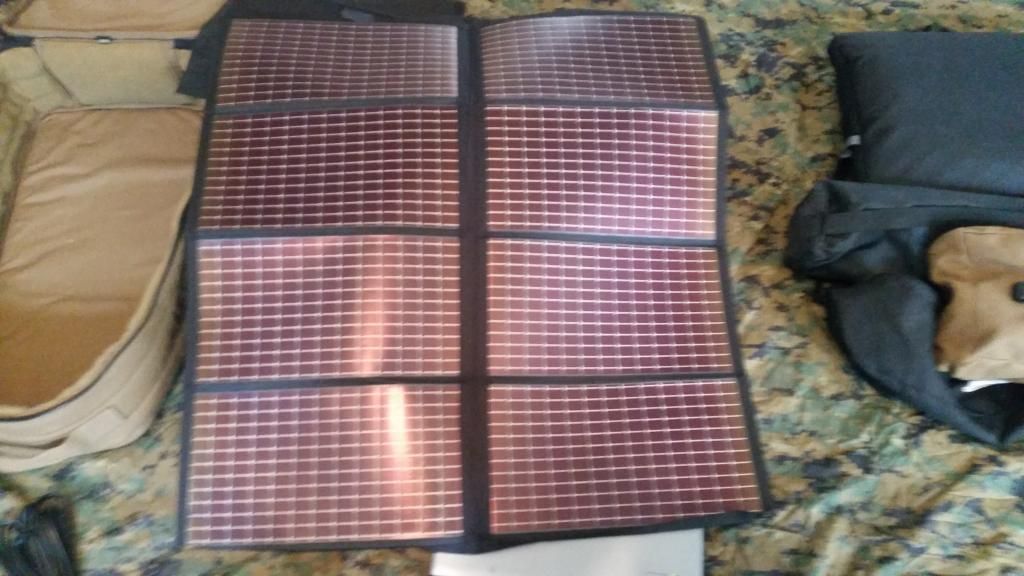
|
I like that panel. How many watts? I have been looking at a "briefcase" folding 60 watt panel on Amazon. Folds up to 13x25" or so. I have a few big 4S LiPo batteries lying around since the FAA required registration and I sold off my drones. I might look into the diode voltage drop method and put them into use. I have a decent "Tenergy" charger that does multiple different battery chemistry I could use, but all the weight and bulk adds up over time. |
|
Quoted:
I like that panel. How many watts? I have been looking at a "briefcase" folding 60 watt panel on Amazon. Folds up to 13x25" or so. I have a few big 4S LiPo batteries lying around since the FAA required registration and I sold off my drones. I might look into the diode voltage drop method and put them into use. I have a decent "Tenergy" charger that does multiple different battery chemistry I could use, but all the weight and bulk adds up over time. The B4 charger is only like 15 bucks, I figure its junk for the most part but its tiny and seems to work fine off 12V so far and if I kill it with an 18V panel (B4 is supposedly rated for 18V) then I'll figure out something else. I did the math on the setup and with a powerfilm panel it comes out to like 2-3lbs IIRC. One thing with regard to that is mission duration, I could carry several charged batteries for the same weight and the powerfilm is expensive, so I'm waiting for a sale or price drops. |