


Posted: 11/23/2013 9:26:29 AM EDT
|
So, I am looking at charge controllers for a very small solar setup (~20W-40W panel) and I am noticing they all have terminals for the panel, the battery and the load.
Do I have to draw the load through the charge controller? What happens if I draw directly from the battery's terminals? Thanks. |
|
Many small charge controllers don't have any connections to the load - They only connect between the panels and the batteries.
Normally, you connect your load directly to the batteries. One exception is with some "diversion" controllers, which automatically connect the panels to a secondary "diversion" load after the batteries reach a full state of charge. Typically, this load is a water heater, attic fan or some other device that allows the panels to do some useful, non-esssential work after it has completed its main job of recharging the batteries. |
As an example, this one purports to be a MPPT Charge Controller.

I guess I just want to make sure I wouldn't be causing damage to solar panel or battery by not drawing a load through the "load" terminals. |
|
Quoted:
As an example, this one purports to be a MPPT Charge Controller. http://ebaypa.com/albums/20120005/sku094798_uk01.jpg I guess I just want to make sure I wouldn't be causing damage to solar panel or battery by not drawing a load through the "load" terminals. In addition to controlling the output of the solar panels, this model also has a low battery voltage disconnect feature - By connecting your DC loads through the controller, they'll automatically get disconnected if the battery becomes excessively discharged, thereby preventing battery damage. The down side of this arrangement is that the maximum current-carrying capacity of the "load" connection is quite limited - Typically no more than the controller's rated charging current. So, you can't connect any high-current loads through it. Note that you don't have to use this feature. There is no harm in connecting your loads directly to the battery terminals instead - and any high-current loads (like inverters) must be connected directly to the battery terminals anyway. |
|
Another dumb question, as long as you guys are in the mood to share your knowledge:
Is there any downside to getting a controller rated to 30amps even though I am going to be STARTING with a measly 20 watt panel? Planning to upgrade to more/larger panels as funds allow. Thanks again. |
|
Quoted:
Another dumb question, as long as you guys are in the mood to share your knowledge: Is there any downside to getting a controller rated to 30amps even though I am going to be STARTING with a measly 20 watt panel? Planning to upgrade to more/larger panels as funds allow. Thanks again. No, no downside to it that I can see, but be careful of the cheaper MPPT controllers. I'm seeing a lot of really inexpensive controllers and I wonder how well they actually work and how robust they are. With higher loads, a good MPPT controller (which are more efficient than PWM controllers) should pay dividends, placing most of the solar energy back into the battery system, but on smaller loads, PWM may actually be more efficient, because there's no real 'processor' to power. Good MPPT controllers from Morningstar, Blue Sky, Rogue, et al., will be more money than a good PWM controller, so >$200 vs. $70? I bought a Morningstar SunSaver 10-L Gen 2. PWM controller and that will do 10 amps. The 'L' model has a low voltage disconnect, as Ski references above. I run two 30w panels for 60w total (~3.5A) and I think that I can move up to a total of 170w, so I have wiggle room for sure. At $70 shipped, buying a 20A, or 30A model isn't a hardship, this is a semi-portable system, so I didn't go that route. Here's my solar rig I put together in August of '12: 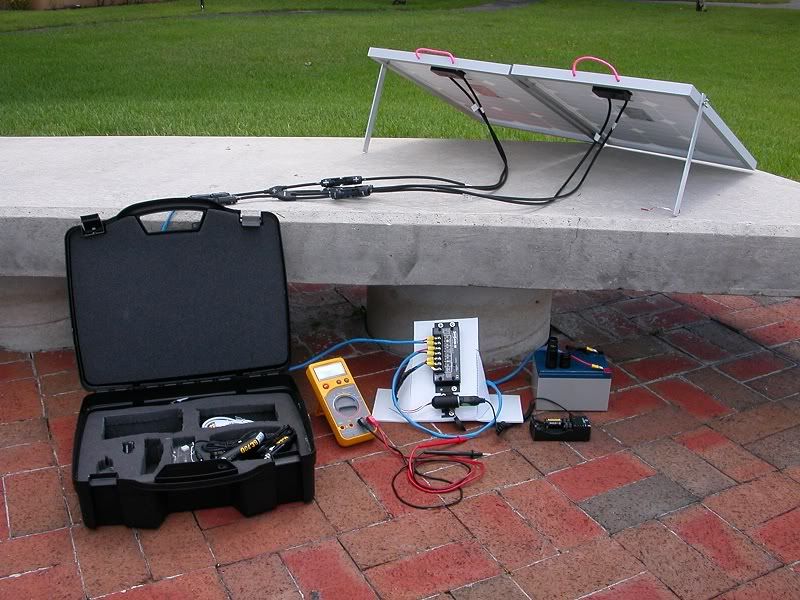
Solar charging rig Chris |
|
One exception is with some "diversion" controllers, which automatically connect the panels to a secondary "diversion" load after the batteries reach a full state of charge. Some wind generators require a diversion load through the controller after the batts are fully charged (power no longer needed) so that the "windmill" does not overspeed and fry itself in a stiff wind. |