


Posted: 4/7/2015 4:11:26 PM EDT
|
I am looking at getting a 10-12kW grid tie system installed in the next month or two. Probably a ground mount, but a roof mount might be a possibility if it makes more sense financially.
First and biggest question: Inverter style. I'm getting two different recommendations: Enphase microinverters and SolarEdge. Both camps seem to think they are the answer. I can see the downside of microinverters, some of which I would offset with a ground mount (having the inverter tech itself exposed to the heat of a roof is likely not a factor). I think overall I am leaning to SolarEdge, but I am having trouble finding true apple to apple recommendations on the subject. Second question: sizing. Should I go a bit bigger and plan for future energy use expansion? Or go a bit more conservative and spend less $ upfront? A bit of information: We average 2248kW/month over a 12 month period for current energy use. Our power bill averages about $500/month with that usage. We are going to use the HERO program to finance it with a 10 year term that makes the payment part of our property tax, increasing the tax benefits since the payment will then be tax deductible as a line item on the property taxes. We are getting quotes showing a price between $4.15-$4.70/installed for ground mount including trenching. Anyone want to throw some additional wisdom my way? It would be much appreciated. |
| grid tie as in it back feeds the power grid? if you are going that route how about cut back on your usage. spend some of that money on updating to energy star appliances, changing out light bulbs for either CFL's or even better LED bulbs, turn up the AC in summer and turn down the heat(if you use heat) in the winter, add insulation to your attic space, seal around all windows and doors to stop drafts, unplug or get smart power strips for anything with a power brick/wall wart so when not needed they arent still draining power from the grid, update windows and doors if they are older/not energy efficient. the goal to get the most return is to reduce what YOU use. same hold true if you were trying to go off grid all together. |
|
The idea of microinverter is if one goes down, the rest of the panels can still produce, as opposed to one failure point of a main inverter. I like my roof mount but it depends how they're installed. My tiles were removed and brackets attached to the truss. No drilling, no chance of leaks. The ground mounts wouldn't have to worry about that but you need land and generally not be in an HOA so I couldn't go that route. Good luck.
And better windows, insulation, and lighting is also very useful as someone else said. |
|
Quoted:Enphase microinverters and SolarEdge. Both camps seem to think they are the answer. I can see the downside of microinverters, some of which I would offset with a ground mount (having the inverter tech itself exposed to the heat of a roof is likely not a factor). Rancher |
|
Quoted:
I'd leave my roof alone...  Yep. I had 14 KC120's on my roof to begin with. Took them down and ground mounted them in 2007 and then had to fix the holes and re-roof. I keep toying with the idea of 5 of these 235 watt panels I had to install putting them on another section of roof that was built better. I talk myself in and out of that.... That's a huge system BTW, course we aren't selling back either. |
|
Neither. I have run the numbers, don't care for the chinese micro-inverters,. I (personally ) DON'T believe the 20 year life span is credible. . Solar Edge system is even worse, as it uses module mount " power conditioners " PLUS a string inverter, which seems like buy ing extra points of failure to me. I like the economics of string inverters. Easy to wire. Mount on wall, connect it up, and ignore it. . Schneider Conext series is inexpensive, efficient, and they work. I have one right outside the door, feed it 300 volts DC @16 Amps, and it pushes 250 volts,AC onto the grid, when the sun is up. |
|
Quoted:
Neither. I have run the numbers, don't care for the chinese micro-inverters,. I (personally ) DON'T believe the 20 year life span is credible.. Solar Edge system is even worse, as it uses module mount " power conditioners " PLUS a string inverter, which seems like buy ing extra points of failure to me. I like the economics of string inverters. Easy to wire. Mount on wall, connect it up, and ignore it. . Schneider Conext series is inexpensive, efficient, and they work. I have one right outside the door, feed it 300 volts DC @16 Amps, and it pushes 250 volts,AC onto the grid, when the sun is up. I put my original Trace 4024 inverter in a metal military medical crate last fall and put a Schneider in. Didn't care for the you have to buy 17 add on modules deal though. No one could tell me (even the manufacturer) if I for sure needed the generator connection "module" to make it work with my ancient China diesel genset. Yet I wired in the AC1 input fired the genset and it synched quickly and start putting AC power in. The DC side of my system goes through a couple of C40's and Outback MX80's to the battery bank of 28 L16's. A LOT has changed since the 90's and at some point in time I think I'll do some further upgrades to the system as well. |
|
Quoted:
Yep. I had 14 KC120's on my roof to begin with. Took them down and ground mounted them in 2007 and then had to fix the holes and re-roof. I keep toying with the idea of 5 of these 235 watt panels I had to install putting them on another section of roof that was built better. I talk myself in and out of that.... That's a huge system BTW, course we aren't selling back either. Quoted:
Quoted:
I'd leave my roof alone... Yep. I had 14 KC120's on my roof to begin with. Took them down and ground mounted them in 2007 and then had to fix the holes and re-roof. I keep toying with the idea of 5 of these 235 watt panels I had to install putting them on another section of roof that was built better. I talk myself in and out of that.... That's a huge system BTW, course we aren't selling back either. Why the dislike of roof mounting? I mounted 30 275w panels on my flat roof. Had the mounts installed on the old roof surface then re-roofed with spray urethane foam encasing the mounting hardware. Installed the panels on the racks and it is 100% watertight. If you do the installation correctly roof mounting has a lot of advantages. 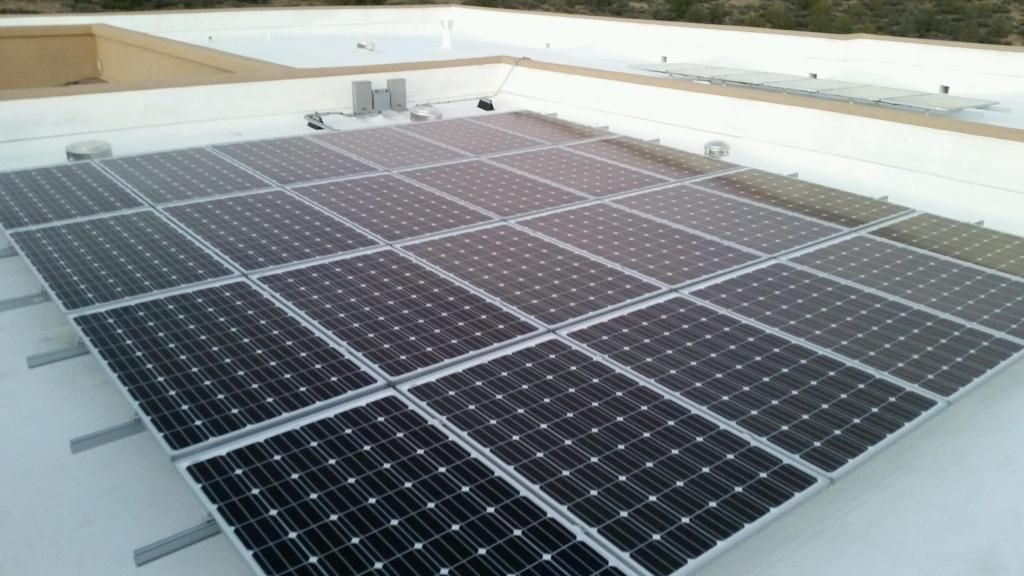
|
|
You must have a pretty big roof Patch! We have about 3.5kw (14 ea 250W Sharp) on the roof of our barn (50x40), and it takes up a ton of space. We maybe could fit in another string, but it'd be tight and suboptimal. If you had dormers, chimney, etc, it'd take a tremendous amount of unobstructed roof space, and likely quite a wind load. Our system is a "grid-interactive", meaning it backfeeds power when the grid is up and the sun is shining, and provides us emergency power when the grid is unavailable. My understanding is that a pure grid-tie system has no batteries and thus provides no power in the event that the AC mains are offline for some reason. It's certainly cheaper to build because of the lack of batteries, but the usefulness is limited to a reduction in monthly utility cost. Our inverter is a Xantrex XW 6048, if you're interested in expanding your search... |
|
Quoted:
You must have a pretty big roof Patch! We have about 3.5kw (14 ea 250W Sharp) on the roof of our barn (50x40), and it takes up a ton of space. We maybe could fit in another string, but it'd be tight and suboptimal. If you had dormers, chimney, etc, it'd take a tremendous amount of unobstructed roof space, and likely quite a wind load. Our system is a "grid-interactive", meaning it backfeeds power when the grid is up and the sun is shining, and provides us emergency power when the grid is unavailable. My understanding is that a pure grid-tie system has no batteries and thus provides no power in the event that the AC mains are offline for some reason. It's certainly cheaper to build because of the lack of batteries, but the usefulness is limited to a reduction in monthly utility cost. Our inverter is a Xantrex XW 6048, if you're interested in expanding your search... My 8.25kw takes up ~550 sq ft, 12kw is a lot for free standing mounts but depending on the roof should be doable. |
|
Quoted:
The idea of microinverter is if one goes down, the rest of the panels can still produce, as opposed to one failure point of a main inverter. I like my roof mount but it depends how they're installed. My tiles were removed and brackets attached to the truss. No drilling, no chance of leaks. The ground mounts wouldn't have to worry about that but you need land and generally not be in an HOA so I couldn't go that route. Good luck. And better windows, insulation, and lighting is also very useful as someone else said. Also, each panel is independently MPPT processing, so each is producing to it's individual maximum potential, increasing overall system production efficiency. Micro inverters are AC tied, so all of the wiring coming from the panels through the disconnect and into the panel is the same as standard house wiring. A 12 gauge 20A 240VAC circuit is a lot cheaper to install than a 600 VDC circuit down to a string inverter. Grid tie micro inverters have anti-islanding and meet the rapid shutdown requirements of the NEC without additional equipment beyond the primary disconnect. |
|
Quoted:
Also, each panel is independently MPPT processing, so each is producing to it's individual maximum potential, increasing overall system production efficiency. Micro inverters are AC tied, so all of the wiring coming from the panels through the disconnect and into the panel is the same as standard house wiring. A 12 gauge 20A 240VAC circuit is a lot cheaper to install than a 600 VDC circuit down to a string inverter. Grid tie micro inverters have anti-islanding and meet the rapid shutdown requirements of the NEC without additional equipment beyond the primary disconnect. Quoted:
Quoted:
The idea of microinverter is if one goes down, the rest of the panels can still produce, as opposed to one failure point of a main inverter. I like my roof mount but it depends how they're installed. My tiles were removed and brackets attached to the truss. No drilling, no chance of leaks. The ground mounts wouldn't have to worry about that but you need land and generally not be in an HOA so I couldn't go that route. Good luck. And better windows, insulation, and lighting is also very useful as someone else said. Also, each panel is independently MPPT processing, so each is producing to it's individual maximum potential, increasing overall system production efficiency. Micro inverters are AC tied, so all of the wiring coming from the panels through the disconnect and into the panel is the same as standard house wiring. A 12 gauge 20A 240VAC circuit is a lot cheaper to install than a 600 VDC circuit down to a string inverter. Grid tie micro inverters have anti-islanding and meet the rapid shutdown requirements of the NEC without additional equipment beyond the primary disconnect. If I didn't want off grid capability from my EV setup I would have gone with the micro inverter panels for the above reasons. |
|
Quoted:
Why the dislike of roof mounting? I mounted 30 275w panels on my flat roof. Had the mounts installed on the old roof surface then re-roofed with spray urethane foam encasing the mounting hardware. Installed the panels on the racks and it is 100% watertight. If you do the installation correctly roof mounting has a lot of advantages. http://i298.photobucket.com/albums/mm273/richardv308/IMG_0001_zpspq1zmupz.jpg Quoted:
Quoted:
Quoted:
I'd leave my roof alone... Yep. I had 14 KC120's on my roof to begin with. Took them down and ground mounted them in 2007 and then had to fix the holes and re-roof. I keep toying with the idea of 5 of these 235 watt panels I had to install putting them on another section of roof that was built better. I talk myself in and out of that.... That's a huge system BTW, course we aren't selling back either. Why the dislike of roof mounting? I mounted 30 275w panels on my flat roof. Had the mounts installed on the old roof surface then re-roofed with spray urethane foam encasing the mounting hardware. Installed the panels on the racks and it is 100% watertight. If you do the installation correctly roof mounting has a lot of advantages. http://i298.photobucket.com/albums/mm273/richardv308/IMG_0001_zpspq1zmupz.jpg On a flat roof with easy access I agree that it makes sense to mt panels -there, like you did. On the barn we have, I mounted some on the strong metal curved roof. On your installation, it seems it would make service/engineering sense to not cluster them all together and instead, leave a path for servicing the inner ones, if it should ever be necessary. For conventional stick built homes with sloping roofs with shingles, I'd be hard pressed to put them up there if I had an alterative. |
|
Quoted:
If I didn't want off grid capability from my EV setup I would have gone with the micro inverter panels for the above reasons. Quoted:
Quoted:
Quoted:
The idea of microinverter is if one goes down, the rest of the panels can still produce, as opposed to one failure point of a main inverter. I like my roof mount but it depends how they're installed. My tiles were removed and brackets attached to the truss. No drilling, no chance of leaks. The ground mounts wouldn't have to worry about that but you need land and generally not be in an HOA so I couldn't go that route. Good luck. And better windows, insulation, and lighting is also very useful as someone else said. Also, each panel is independently MPPT processing, so each is producing to it's individual maximum potential, increasing overall system production efficiency. Micro inverters are AC tied, so all of the wiring coming from the panels through the disconnect and into the panel is the same as standard house wiring. A 12 gauge 20A 240VAC circuit is a lot cheaper to install than a 600 VDC circuit down to a string inverter. Grid tie micro inverters have anti-islanding and meet the rapid shutdown requirements of the NEC without additional equipment beyond the primary disconnect. If I didn't want off grid capability from my EV setup I would have gone with the micro inverter panels for the above reasons. "A 12 gauge 20A 240VAC circuit is a lot cheaper to install than a 600 VDC circuit down to a string inverter." You prolly meant a 10 ga circuit. But either way, you still have to provide a physical path for the circuit between the panels and the inverter, and putting some wiring in [flexible ?] conduit for 600 vdc from the panels isn't that big of a deal, vs the 240 ckt. |
|
Quoted:
"A 12 gauge 20A 240VAC circuit is a lot cheaper to install than a 600 VDC circuit down to a string inverter." You prolly meant a 10 ga circuit. But either way, you still have to provide a physical path for the circuit between the panels and the inverter, and putting some wiring in [flexible ?] conduit for 600 vdc from the panels isn't that big of a deal, vs the 240 ckt. Quoted:
Quoted:
Quoted:
Quoted:
The idea of microinverter is if one goes down, the rest of the panels can still produce, as opposed to one failure point of a main inverter. I like my roof mount but it depends how they're installed. My tiles were removed and brackets attached to the truss. No drilling, no chance of leaks. The ground mounts wouldn't have to worry about that but you need land and generally not be in an HOA so I couldn't go that route. Good luck. And better windows, insulation, and lighting is also very useful as someone else said. Also, each panel is independently MPPT processing, so each is producing to it's individual maximum potential, increasing overall system production efficiency. Micro inverters are AC tied, so all of the wiring coming from the panels through the disconnect and into the panel is the same as standard house wiring. A 12 gauge 20A 240VAC circuit is a lot cheaper to install than a 600 VDC circuit down to a string inverter. Grid tie micro inverters have anti-islanding and meet the rapid shutdown requirements of the NEC without additional equipment beyond the primary disconnect. If I didn't want off grid capability from my EV setup I would have gone with the micro inverter panels for the above reasons. "A 12 gauge 20A 240VAC circuit is a lot cheaper to install than a 600 VDC circuit down to a string inverter." You prolly meant a 10 ga circuit. But either way, you still have to provide a physical path for the circuit between the panels and the inverter, and putting some wiring in [flexible ?] conduit for 600 vdc from the panels isn't that big of a deal, vs the 240 ckt. No, I meant 12 AWG for 20A 10 AWG is for 30A There are more costs associated with a long DC run. A high volt DC disconnect is a bigger deal and more expensive than a standard AC disconnect. The reason you would go with that high of a voltage in a DC circuit is to keep the wire size reasonably priced without significant voltage drop. |
|
Quoted:
No I meant 12 AWG for 20A 10 AWG is for 30A A high volt DC disconnect is a bigger deal and more expensive than a standard AC disconnect, such as a 100A. The reason you would go with that high of a voltage in a DC circuit is to keep the wire size reasonably priced without significant voltage drop. Quoted:
Quoted:
Quoted:
Quoted:
Quoted:
The idea of microinverter is if one goes down, the rest of the panels can still produce, as opposed to one failure point of a main inverter. I like my roof mount but it depends how they're installed. My tiles were removed and brackets attached to the truss. No drilling, no chance of leaks. The ground mounts wouldn't have to worry about that but you need land and generally not be in an HOA so I couldn't go that route. Good luck. And better windows, insulation, and lighting is also very useful as someone else said. Also, each panel is independently MPPT processing, so each is producing to it's individual maximum potential, increasing overall system production efficiency. Micro inverters are AC tied, so all of the wiring coming from the panels through the disconnect and into the panel is the same as standard house wiring. A 12 gauge 20A 240VAC circuit is a lot cheaper to install than a 600 VDC circuit down to a string inverter. Grid tie micro inverters have anti-islanding and meet the rapid shutdown requirements of the NEC without additional equipment beyond the primary disconnect. If I didn't want off grid capability from my EV setup I would have gone with the micro inverter panels for the above reasons. "A 12 gauge 20A 240VAC circuit is a lot cheaper to install than a 600 VDC circuit down to a string inverter." You prolly meant a 10 ga circuit. But either way, you still have to provide a physical path for the circuit between the panels and the inverter, and putting some wiring in [flexible ?] conduit for 600 vdc from the panels isn't that big of a deal, vs the 240 ckt. No I meant 12 AWG for 20A 10 AWG is for 30A A high volt DC disconnect is a bigger deal and more expensive than a standard AC disconnect, such as a 100A. The reason you would go with that high of a voltage in a DC circuit is to keep the wire size reasonably priced without significant voltage drop. Agree w/ you re the 12/10 ga. 10 ga will have less loss, but 12 ga is approved. |
|
Quoted:
Agree w/ you re the 12/10 ga. 10 ga will have less loss, but 12 ga is approved. Just stating the standards, there are exceptions of course. You'd have to do a voltage drop calc for a long run, but for something like a roof mount down to the load center on a standard house, I'm sure 12 AWG would be fine. Just like running 12 AWG from the load center to a 20 A circuit somewhere in the house. That's one thing I really like about the AC connected systems, once the power comes off the inverters it's wired just like any other household circuit (or nearly so). |
|
Quoted: No, I meant 12 AWG for 20A 10 AWG is for 30A There are more costs associated with a long DC run. A high volt DC disconnect is a bigger deal and more expensive than a standard AC disconnect. The reason you would go with that high of a voltage in a DC circuit is to keep the wire size reasonably priced without significant voltage drop. Quoted: Quoted: Quoted: Quoted: Quoted: The idea of microinverter is if one goes down, the rest of the panels can still produce, as opposed to one failure point of a main inverter. I like my roof mount but it depends how they're installed. My tiles were removed and brackets attached to the truss. No drilling, no chance of leaks. The ground mounts wouldn't have to worry about that but you need land and generally not be in an HOA so I couldn't go that route. Good luck. And better windows, insulation, and lighting is also very useful as someone else said. Also, each panel is independently MPPT processing, so each is producing to it's individual maximum potential, increasing overall system production efficiency. Micro inverters are AC tied, so all of the wiring coming from the panels through the disconnect and into the panel is the same as standard house wiring. A 12 gauge 20A 240VAC circuit is a lot cheaper to install than a 600 VDC circuit down to a string inverter. Grid tie micro inverters have anti-islanding and meet the rapid shutdown requirements of the NEC without additional equipment beyond the primary disconnect. If I didn't want off grid capability from my EV setup I would have gone with the micro inverter panels for the above reasons. "A 12 gauge 20A 240VAC circuit is a lot cheaper to install than a 600 VDC circuit down to a string inverter." You prolly meant a 10 ga circuit. But either way, you still have to provide a physical path for the circuit between the panels and the inverter, and putting some wiring in [flexible ?] conduit for 600 vdc from the panels isn't that big of a deal, vs the 240 ckt. No, I meant 12 AWG for 20A 10 AWG is for 30A There are more costs associated with a long DC run. A high volt DC disconnect is a bigger deal and more expensive than a standard AC disconnect. The reason you would go with that high of a voltage in a DC circuit is to keep the wire size reasonably priced without significant voltage drop. I run one array at 300 volts DC, 16 amps, and have less than half percent line loss. second array is a pretty long run, 360 volts DC, 10 amps with 10 gauge wire, my recollection was around 0.3 percent line loss. I am not saying that you SHOULDN't use AC for long runs, but don't pretend that AC will reduce line loss. It won't. |
|
Quoted:
2 reasons to use DC runs from panels are LOWER losses, and smaller(cheaper) wire cost. I run one array at 300 volts DC, 16 amps, and have less than half percent line loss. second array is a pretty long run, 360 volts DC, 10 amps with 10 gauge wire, my recollection was around 0.3 percent line loss. I am not saying that you SHOULDN't use AC for long runs, but don't pretend that AC will reduce line loss. It won't. 
I think you may be confusing higher voltages with the difference between AC and DC. 10 Amps at 120VAC is less than 14 gauge. 14 AWG is rated for 15 Amps, 12 AWG is rated for 20 Amps and 10 AWG is rated for 30 Amps - AC. There's a reason the utilities use AC and not DC. Tesla and Edison were in a war over it. |
|
Enphase micro inverters have worked well for me and the research I did before buying lead me to conclude that they are a well engineered product. I can't speak to the Solaredge micro inverters. Expanding a grid tied enphase micro inverter solar array later should be pretty easy assuming the cabling is planned carefully ahead of time (max of ~17 micro inverters per leg and only so many legs can be junctioned together before other steps are necessary). I'm not sure how many inverters the enphase envoy can monitor so that might be a consideration for future expansion expense as well.
Keep in mind that if you go with a grid tied system using micro inverters you will have a hard time making it grid interactive down the road. Micro inverters can't produce 60 hertz grid quality power on their own, they can only detect and bond to an existing 60 hertz AC wave form. So, when the grid is down the micro inverters will turn off. If you think you can trick them into running using a generator or other means you need to know that this is very difficult. Without the grid there is nowhere for the electricity to go and an over voltage situation will occur and the inverters will shutdown. Anyway, the major players in the industry have been working on ways of making this work (look into "AC Coupling") because down the road lots of customers decide they want a grid interactive system but don't want to take a loss on the wiring and micro inverters (or their solar array is to far away from their proposed battery bank to make a DC run tenable). The solutions are not cheap and not very elegant at the moment (in my opinion). I like my grid tied system and I don't plan on switching to a grid interactive system until the AC coupling problem is 2nd generation solved AND someone comes up with massive, cheap, and long lived battery technology. |