


Posted: 4/9/2026 3:21:57 AM EDT
 Les (Jim) Fischer BigJimFish Written: March 9, 2026 Table of Contents: - Background - Look and Feel - Reticle - Comparative Optical Evaluation - Mechanical Testing - Summary and Conclusion - Your Pro and Con Breakdown: - Testing Methodology Link to the shortened video version of this MeproLight MVO 3-18x44 review for the illiterate Background: Meprolight is new to the magnified rifle scope market, but has been around for a long time and is best knows for their extensive line of red dot and tritium sights for both handgun and rifle. They are a division of SK group, a massive Israeli defense contractor that you probably also recognize Israel Weapon Industries (IWI) from for their popular firearms. Interestingly, the SK group also makes some larger and higher tech things as well, including naval vessels, sense-through-the-wall technology, and armored vehicles. Meprolight’s new line of magnified optics, the MVO line, launched just last year with a 1-8x28mm FFP model and was expanded this year to include a 6-36x56mm FFP model and the 3-18x44 FFP model I will be examining. The particular model I am looking at is made in Taiwan, suggesting that Meprolight is using an OEM for this line, and similarities in specifications indicate this OEM may be Leapers, who just built a new optics factory in Taiwan for its Integrix line of scopes. Either way, this will be a very interesting review for me as it will not be an optical design I have seen before. 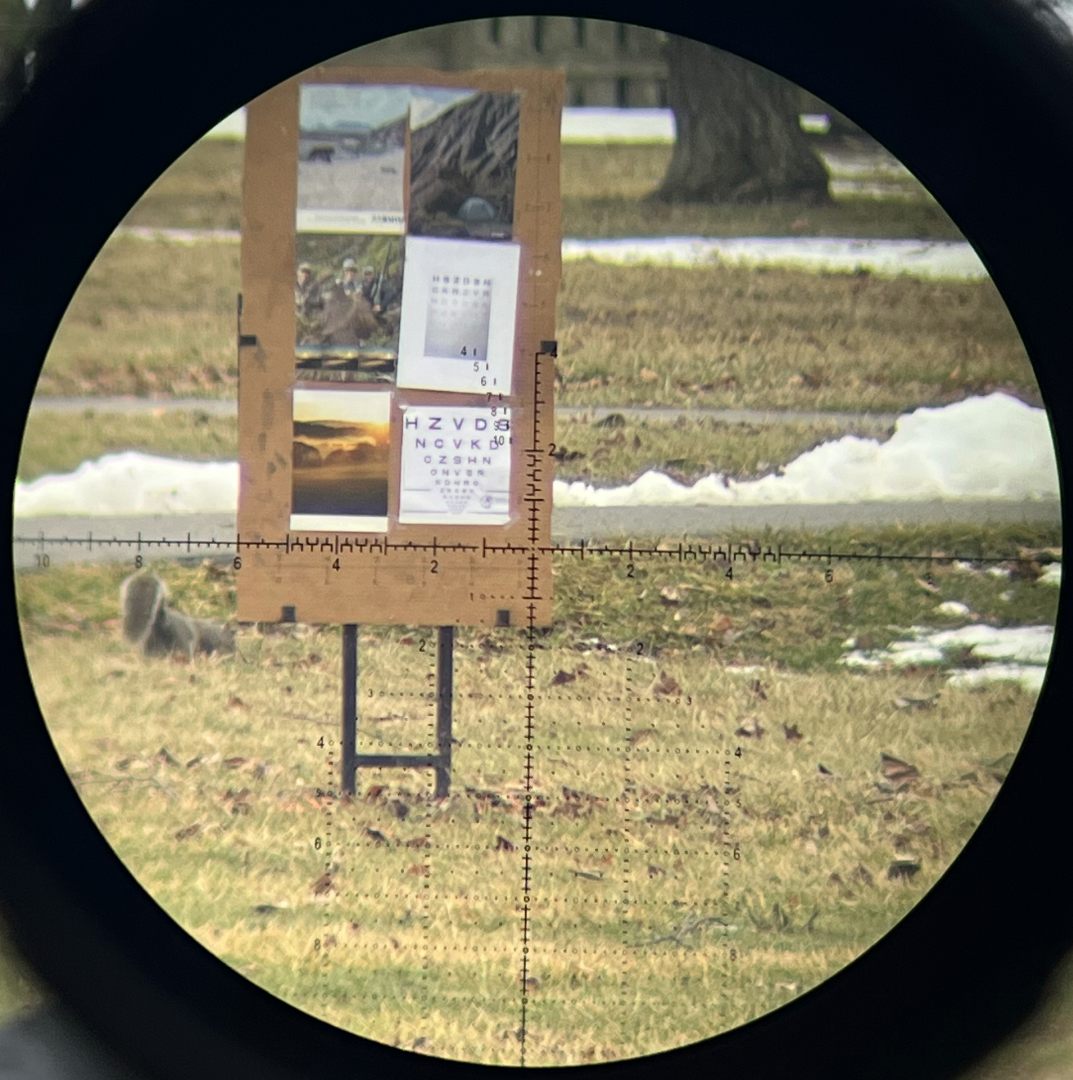 A happy little squirrel showed up to keep me company while doing the mechanical testing of the Meprolight MVO 3-18x44 ffp Look and Feel: The Meprolight MVO 3-18x44 ffp is an aggressive optical design. At 3-18x, it has a large 6x erector ratio and at just 11.89” long, it is very short. It is also quite light at 29.7oz and, with a small 44mm objective, is quite low profile. The knurling on the turrets has a nice look to it and provides plenty of grip while also not trying to double as an exfoliation device. The power ring has a built in ½” throw lever and moves smoothly with well-calibrated force, whereas the euro-style diopter moves a bit too easily. The side focus parallax has good feel and adjusts from 30yds to infinity. Integrated into the parallax knob is the illumination control. This is a push button system and provides two color choices, red and green, instead of just one. A single click turns the illumination on. Further clicks adjust brightness, a long hold changes color, and a longer hold turns it off. The illumination will also automatically power itself off after 12 hours. The turrets pull up to unlock and down to lock at any position. The elevation turret is 10mils per turn, translating, and has a zero stop. Unlike most translating turrets, you cannot user select for an amount of travel below zero, and that amount of travel is none. I do not support this design choice as it excludes those who use zeros that require a little bit of travel below zero at some distances and will also frequently make changing the zero from one ammunition to another take an extra step. Also unlike most translating turrets, after zeroing the turret, the Meprolight always starts in the lowest position on the stem regardless of where in the full range of travel the zero is. This is quite nice as the zeroed starting position of the elevation turret is typically somewhere middlish on most scopes of this type and that makes it pretty hard to remember how many turns up you have gone as it’s easy to forget your starting point - and the lines don’t line up with revolutions anyway. Each subsequent turn on the Meprolight is marked on the turret’s stem and since it all lines up, this makes for a very nice rev indicator. The zero stop on the elevation turret is set by first adjusting the scope so that the aim point and impact point are the same. You then lock the turret in down position, loosen its set screws, rotate the turret counterclockwise until it stops with the zero aligned with indication tick on the scope body, and re-tighten the set screws. If you’re thinking this all sounds more like a non-translating turret than a translating one, you would be correct. The Meprolight turret basically operates exactly like a non-translating turret except that you read the turn you are on from the turret stem instead of something like a pop-up indicator. Resetting the windage turret works in similar manner to the elevation turret. The windage turret has a stop at 7.7 mils each way from zero. The turret feel is good on both of these turrets. It is characterized by very positive clicks, and little resistance between clicks without it being difficult not to lose count or make only one click at a time. This is a difficult balance to achieve and a feel that most users appear to desire. 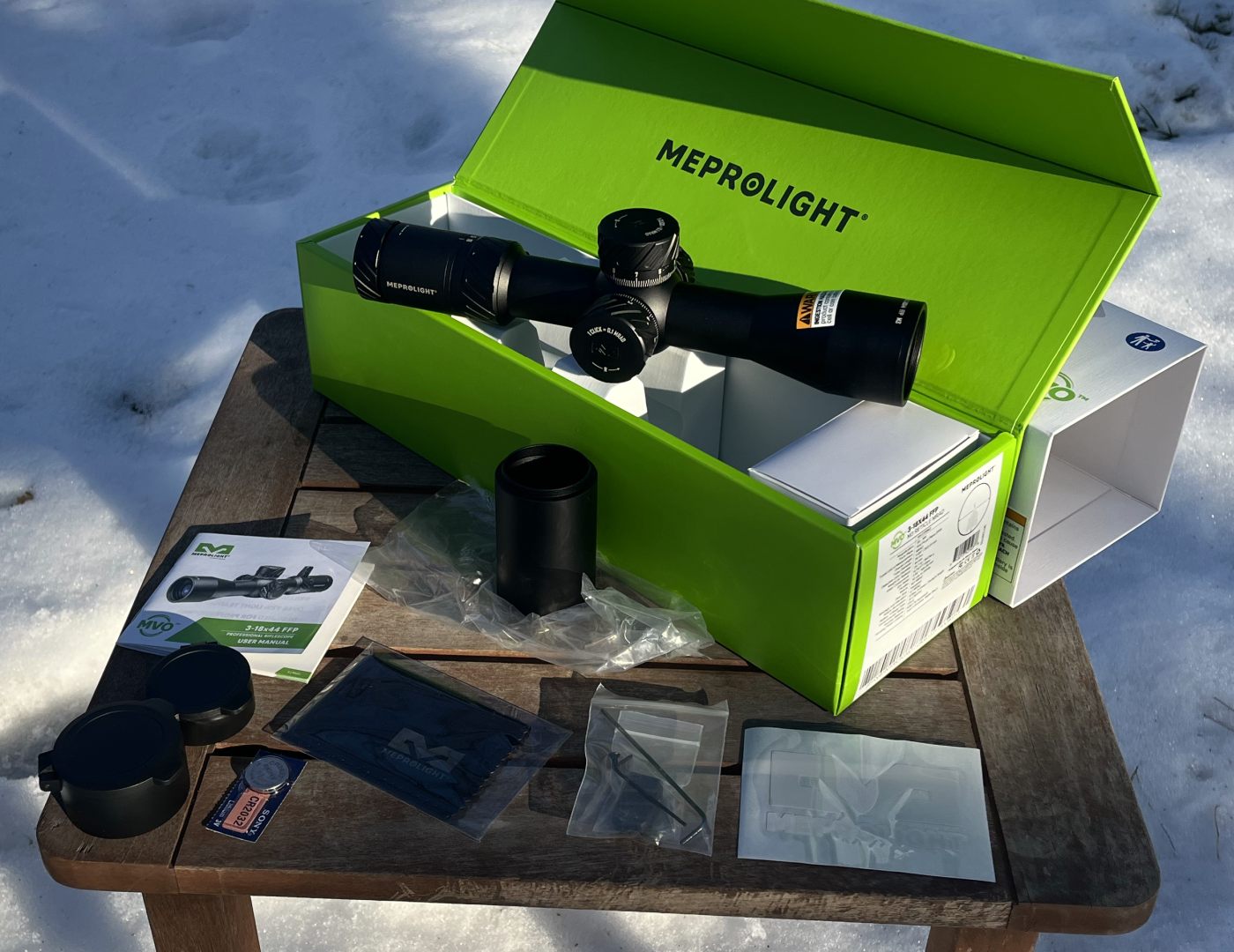 Meprolight MVO 3-18x44 ffp unboxing Included with the scope is a pretty good suite of extras. You get basic flip-open scope caps, a thread-in sunshade, a throw lever extender, a lens cloth, the hex wrenches necessary for operating the scope, a battery, a decal, and the manual. All of this comes in a fancy paperboard box with neodymium closure, debossed logo, and a slip sleeve. 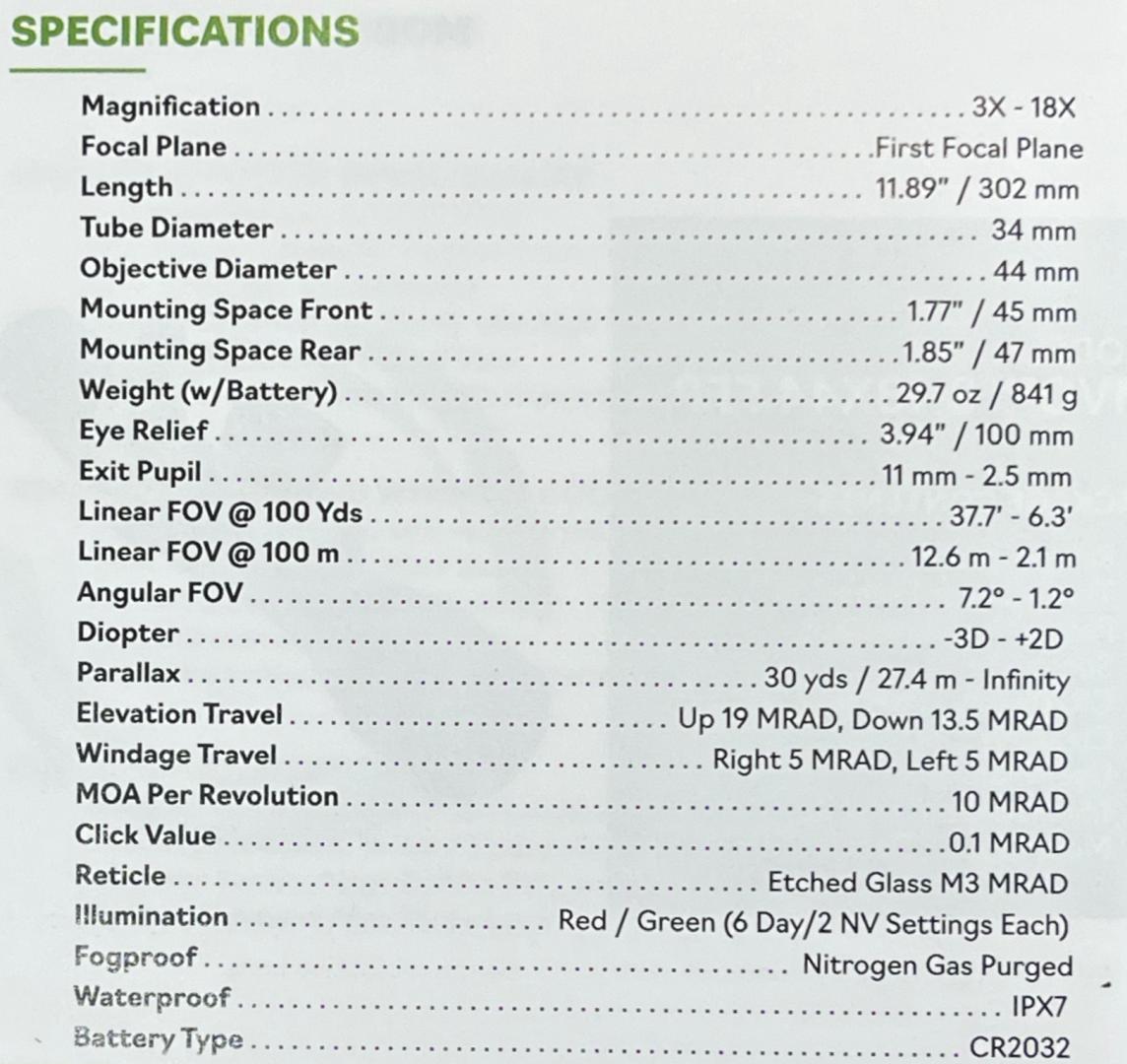 Meprolight MVO 3-18x44 ffp specifications Reticle: The Meprolight MVO 3-18x44 ffp comes in just one reticle at this time. It is called the M3 MRAD. This is a mil grid style reticle with mostly .2mil graduations, both on the crosshairs and in the grid area where you get chains of vertical .2mil graduations every 2 mils to go with the horizontal ones you get every mil. The center of the reticle is a floating dot and there are sections at 12, 3, and 9 o’clock that have unique “Y” shaped graduations creating .1mil divisions. The 12 o’clock crosshair has partially been abbreviated by extending only 4 mils above the horizon, and offset from it is a small fatal funnel feature based on 18” horizontal dimensions calibrated for between 400 and 1000 yards. At max power, only thin graduated sections of the reticle are visible, but as you zoom out you find the crosshairs become thicker at 3, 6, and 9 o’clock to help the reticle stay visible at lower power and in low light. Continue to zoom out and the reticle is revealed to be floating, as the stadia do not continue all the way to the edge of the field of view. In general, labels on the reticle are made every 2 mils. The illumination of the M3 MRAD reticle lights only the center 1 mil in every direction with additional single illuminated dots at 1mil increments on the 6 o’clock crosshair. If you’re inclined to like grid style reticles, you will probably like this one. There weren’t any features I found obviously problematic. If, however, you find grid reticle sections to be simultaneously too gossamer to be useful and yet still distracting, then you will doubtless find that of this one as well because… it’s a grid reticle. 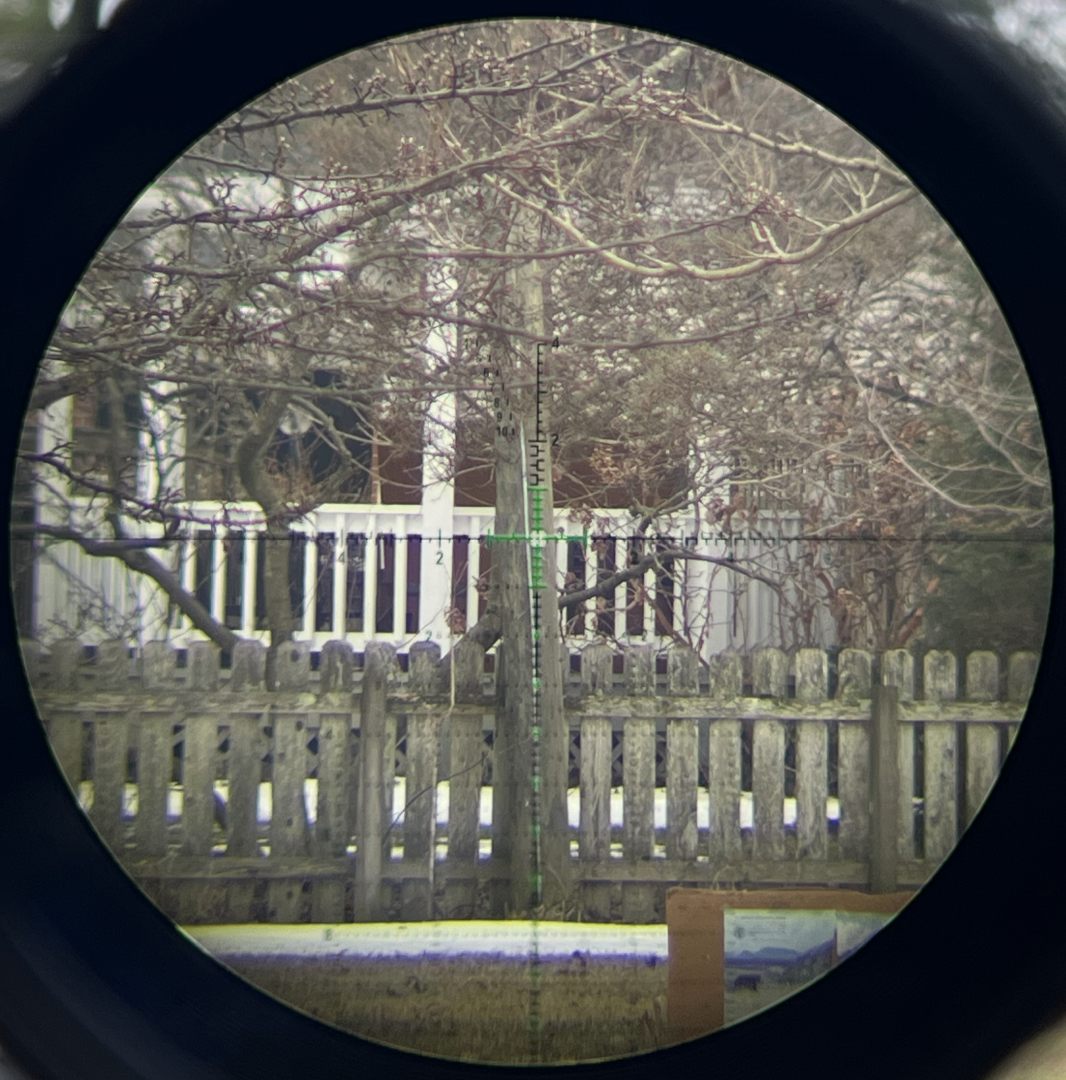 Meprolight MVO 3-18x44 ffp M3 MRAD reticle illuminated green Comparative Optical Evaluation: Now, we get to the most interesting part (for me, anyhow). The Meprolight MVO 3-18x44 is a very small, light scope with a high magnification ratio - and that makes optical design challenging. Had it been able to keep up with the scopes at the MSRP price point (and when I looked though it for my first impressions I though it would), it would have been game changing. Sadly, once I lined everything up side-by-side, the realities of physics and economics weighed in. Being small, light, and having a high magnification ratio mean some compromises and, if the budget is not unlimited, some more compromises. In the end, I used just one ~$2k scope, the Sightron S6 5-30x56, in the lineup and added the ~$1.5k Leupold Mark 4HD 4.5-18x52 and ~$1k Athlon Ares BTR 4.5-27x50mm. 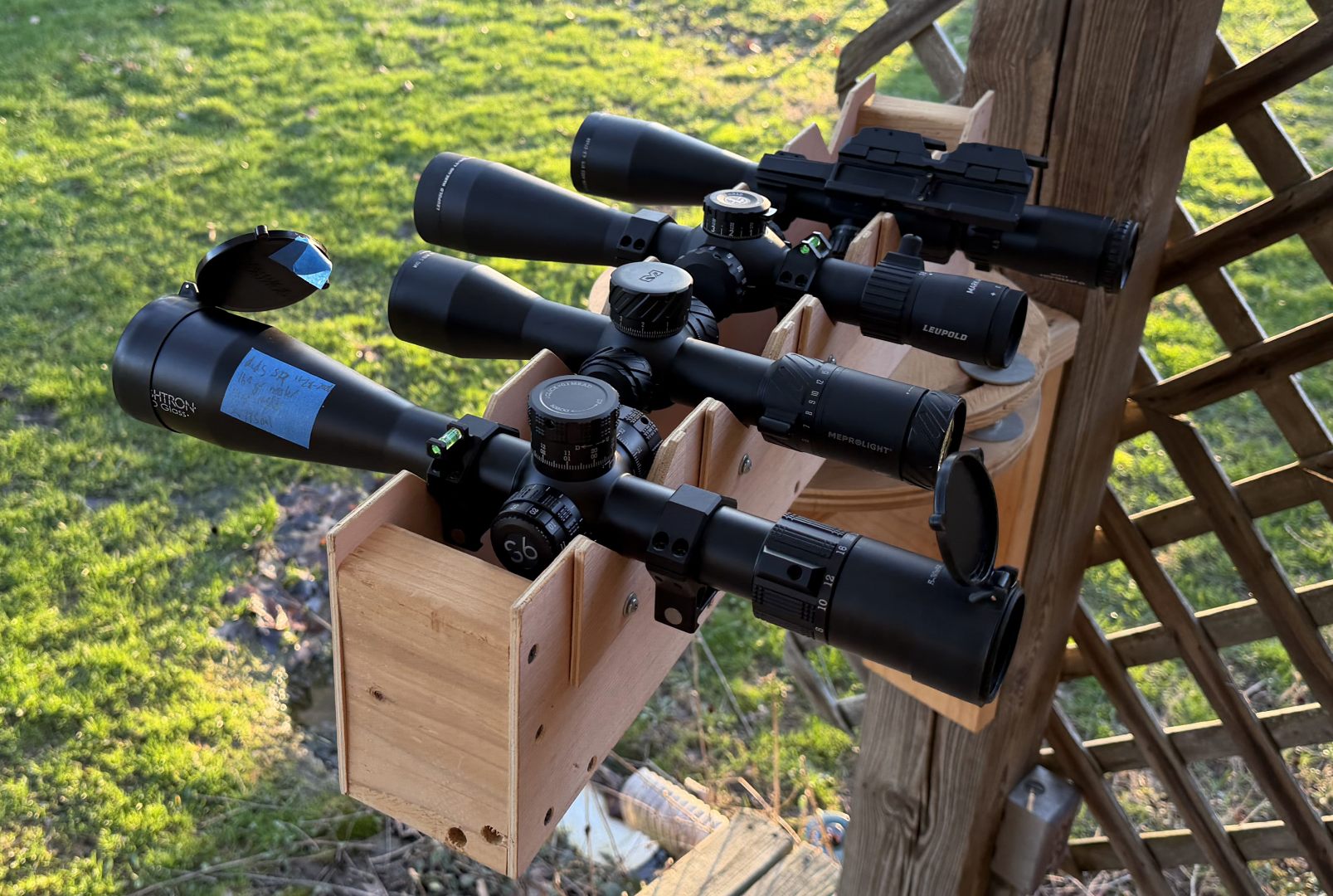 The optical test lineup, near to far: Sightron S6 5-30x56, Meprolight MVO 3-18x44, Leupold Mark 4HD 4.5-18x52, and Athlon Ares BTR 4.5-27x50 I’ll start with field of view because this is where I usually start and the Meprolight MVO 3-18x44 did well here. I have created a condensed statistic for this. I call it the FoV multiplier (FoVX). The FoVX is calculated ((max power * FoV @ max mag in ft) + (min power * FoV @ min mag in ft)) / 2. This gives a number that basically averages how good the FoV of a scope is at both ends of its power range. For this statistic, the Meprolight put in a good score at 113.25. It was essentially tied with the Sightron and was well ahead of the other two optical comparison scopes. In addition to field of view, the Meprolight also excelled at chromatic aberration. Here it barely trailed the Sightron and was a little better than the Leupold Mark 4HD and Athlon Ares. This is very good indeed as none of these scopes have very problematic chromatic aberration. The Meprolight also had good depth of field, being just behind only the Leupold. Its color rendition was also okay, being pretty even with the Leupold and ahead of the Athlon, though well behind the Sightron. The Meprolight also has good stray light handling, an aspect of performance that is tremendously important as poor performance can completely white out your ability to see a target, with disastrous results. It also has low barrel and pincushion distortion, which is good, but really only matters on LPVO optics. Where the wheels started to come off was resolution. It was well behind both the Leupold and Sightron here and, depending on the magnification setting, traded places with the much lower cost Athlon, with the Meprolight being better at higher magnifications and the Athlon at lower. The Meprolight was also bested by all comparisons in edge-to-edge performance, contrast, eyebox (though it was still fine), and, unsurprisingly given the 44mm objective, low light. The edge-to-edge performance was particularly poor at lower powers where it gets a bit finicky and falls off quickly if the eye relief isn’t just perfect. There is no way to sugarcoat it: the Meprolight MVO 3-18x44 pays for its aggressive optical design. It does not perform to its price on most optical performance metrics, including the most important one - resolution. 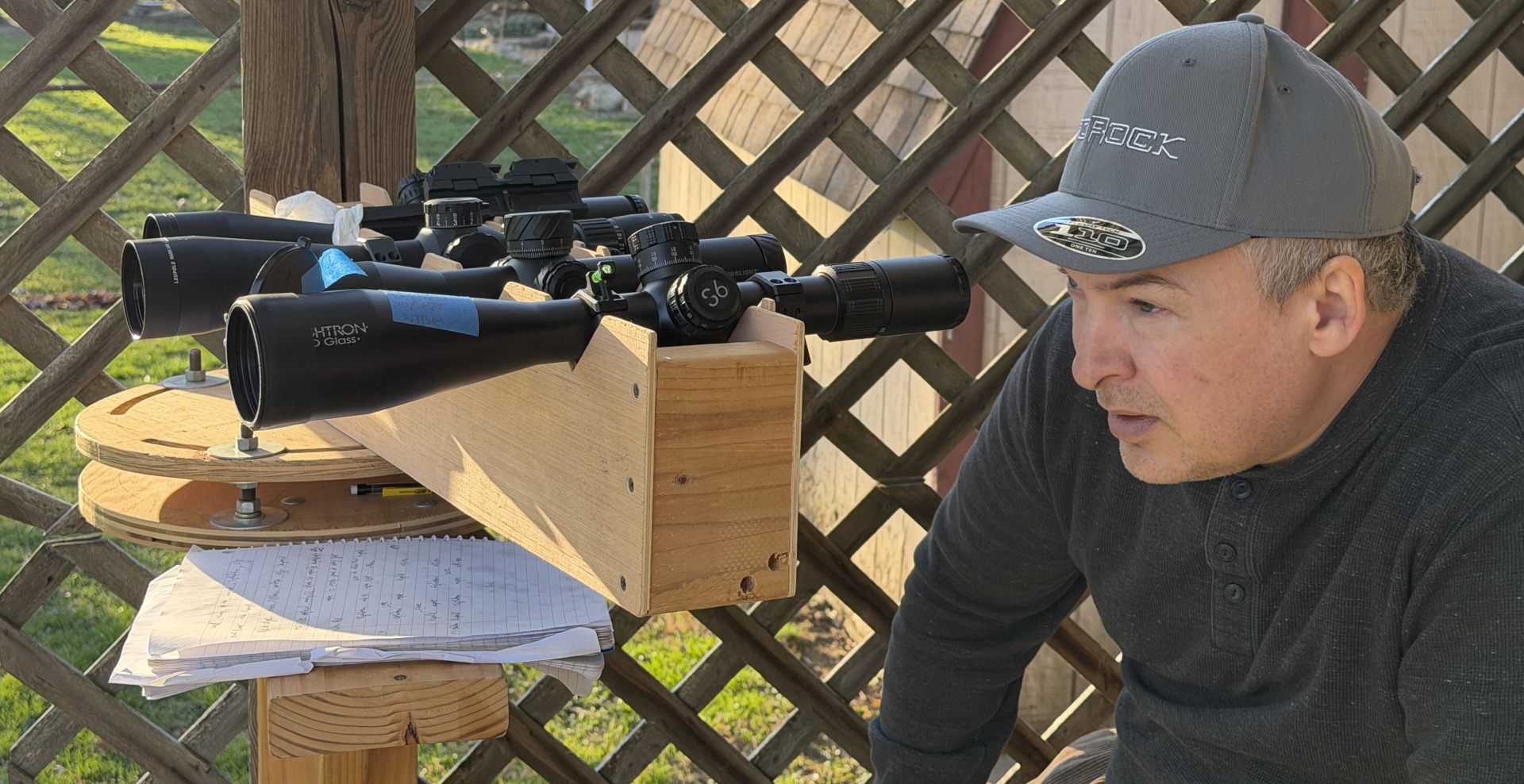 What a beautiful day to finish up the last of the optical testing on the Meprolight MVO 3-18x44 Mechanical Testing: Most scopes have some deviation from perfect adjustment magnitude, though they are doing far better now than just a few years ago. This adjustment magnitude error will vary from example to example within the same model of scope. This is because it is not a product of design errors, but rather variances introduced within manufacturing and assembly, so the performance of my test samples is a piece of information with only limited value due to representing only one example. Typically, we measure adjustment magnitude error as a percentage such that a scope whose reticle moves 10.1 mils when adjusted 10.0 mils tracks at 101% and one whose reticle moves 9.9 mils when 10.0 is dialed tracks at 99%. Having reviewed and tested quite a number of scopes from a large selection of manufacturers, I can tell you that the average deviation in adjustment magnitude from ideal is almost exactly 1%, if the two past scopes that failed tracking (and therefore can’t be linearly assessed) are not included. Reticle size deviation is close to that of adjustments at .9%. The average reticle cant measured is .07 mils in 10 mils traveled or .4 degrees. 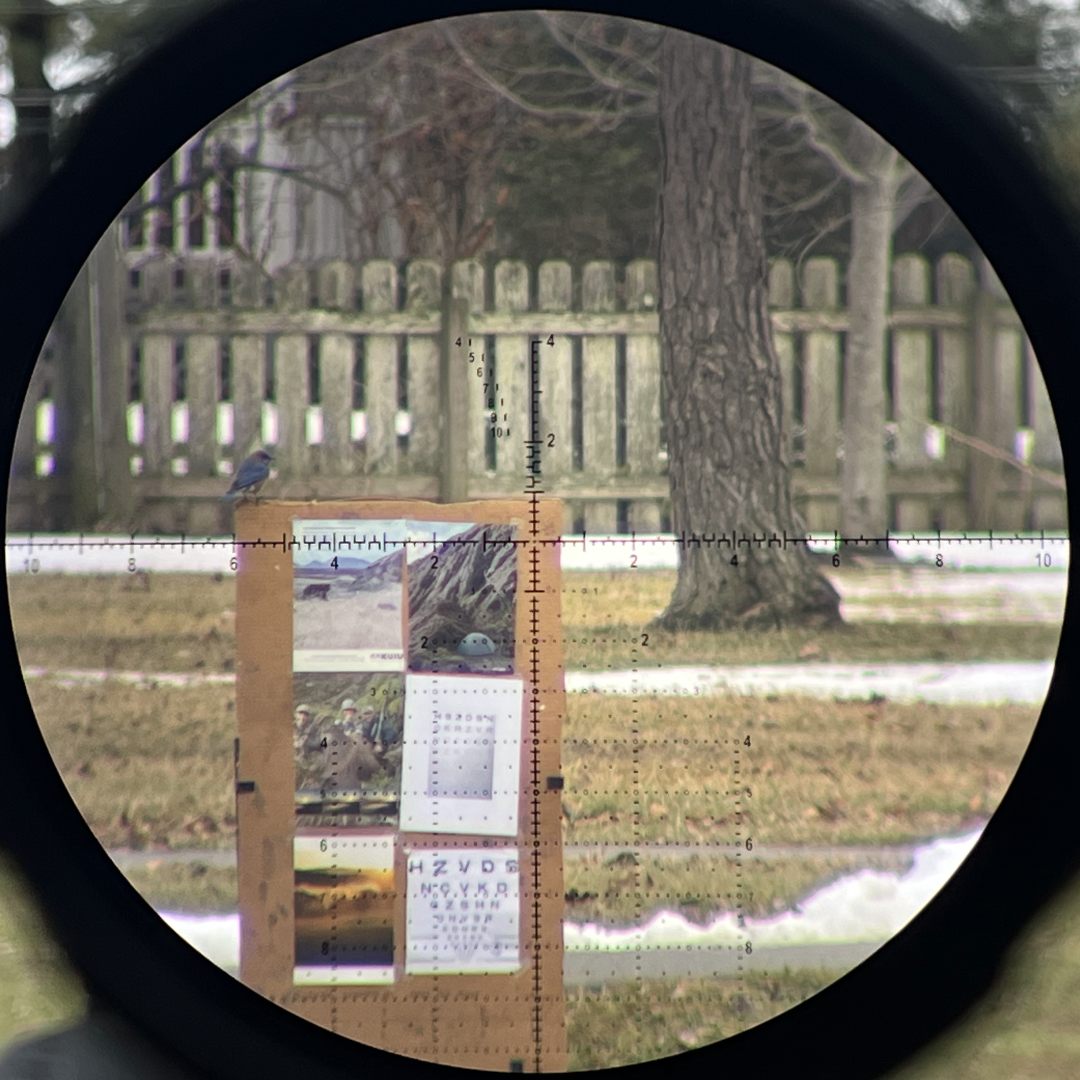 A little birdie joined the squirrel in helping me test the mechanical function of the Meprolight MVO 3-18x44 In the example I tested (there will be sample to sample variance on all these metrics) 10.0 mils on the reticle was 10.0 mils on the calibrated test target for a perfect score. 10.0 mils on the adjustments were 10.3 mils on the target for a 3% error. There were .075 mils lateral drift in the reticle at 10.0 mils traveled for .43 degrees of reticle cant. There was no POI shift with power ring, diopter, or parallax. There was also no spline slop in the elevation adjustment, though it is unclear if a spline is present to have slop in this design, as most translating turrets do not have one. I measured 19.5 mils up from center and 15.2 mils below for a total travel of 34.9. There was no ghost movement at either end of the adjustment and no tubing out when adjusting the windage at max elevation. The windage knob turns 7.7 mils right and 7.8 mils left before the stop. There was no point of aim shift with diopter, power ring, or parallax, and the scope tracked properly back to zero after a box test. Mechanically, this scope passes with pretty average overall scores. The 3% adjustment magnitude was a little higher than normal, but that is also the aspect of mechanical performance most easy to correct for as, if unrealized and uncorrected, it will still almost completely disappear into the shooter’s corrected DOPE. It will be compensated for in the calculator by some combination of initial velocity and projectile BC. Summary and Conclusion: Meprolight has entered the magnified riflescope space with a compelling lineup of scopes. They have an LPVO that looks attractive for ARs or dangerous game rifles in the 1-8x28mm FFP model, a full size, full weight precision rifle scope with the 6-36x56mm FFP, and this exceptionally small and lightweight 3-18x44 FFP crossover optic that has appeal for hunting, precision rifle, and DMR type applications. For consisting of only three rifle scopes, this is a very well laid out product line and begs the question I often ask of optical lines: why do so many companies have so many scope models that are so similar? 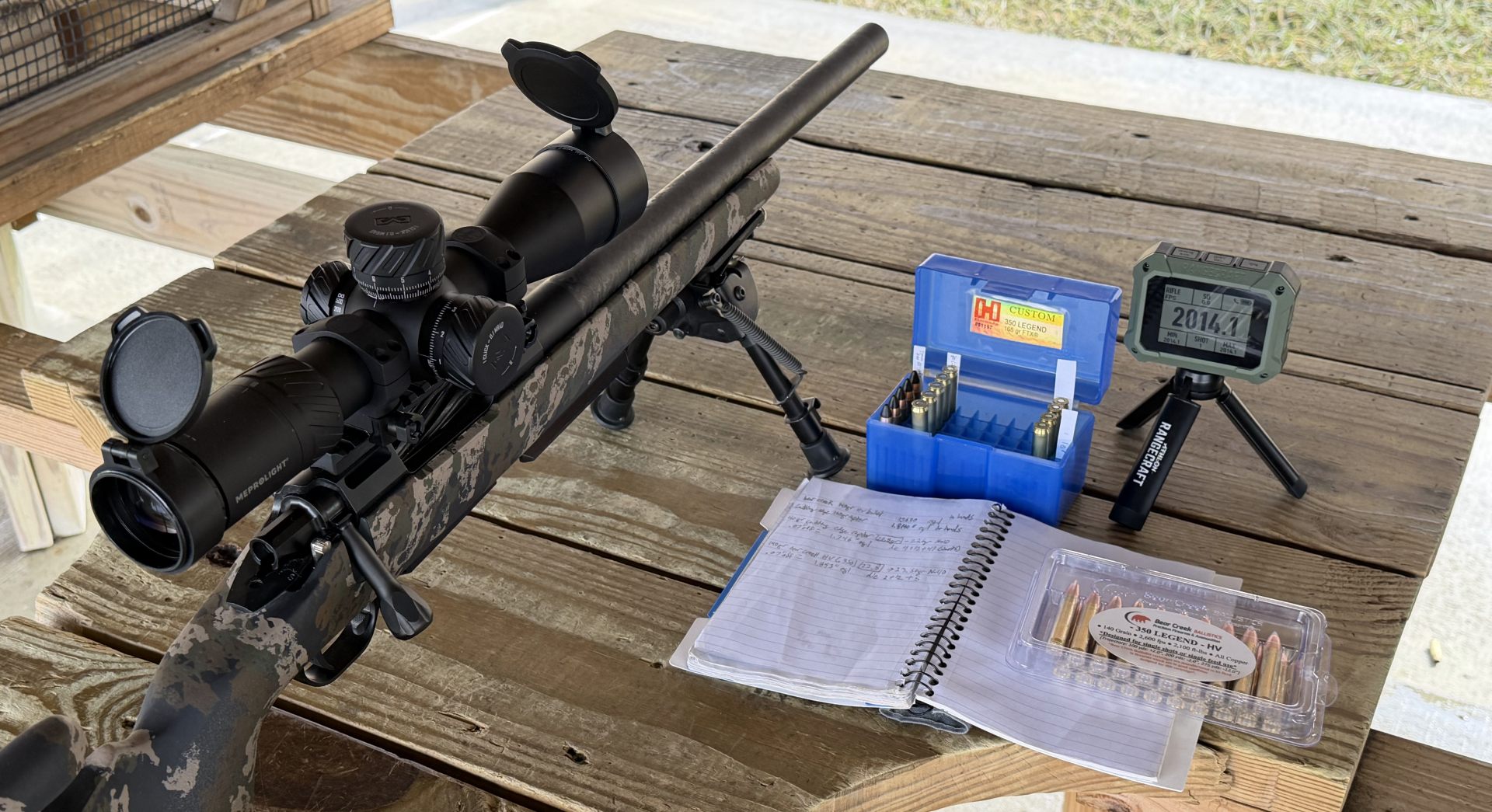 Doing some load testing with the Meprolight MVO 3-18x44 ffp on the PurePrecision SKLTN 350L rifle with the Athlon chronograph Much of what makes the Meprolight MVO 3-18x44 ffp compelling is its aggressive combination of very low weight (29.7oz), small size (11.89”), and high magnification ratio (3-18x). The physics of doing this are very difficult and the optical performance suffered accordingly, with the Meprolight MVO 3-18x44 ffp generally not performing competitively with less aggressively designed scopes in its price range. I would say the optical performance was closer to, though better than, competitive scopes in ~$1k price range than it was to scopes in the ~$1.5-$2k range. It was disappointing optically, particularly with regards to its resolution and edge-to-edge performance, though it did handle chromatic aberration and stray light well, which is difficult to do with an aggressive optical design. Mechanically, the Meprolight MVO 3-18x44 ffp was much more solid, with about average mechanical testing results, good turret feel, and a locking turret feature that will be nice for a lot of the potential use cases. The only issue I had mechanically was the lack of any travel below zero on the zero stop system. This will interfere with the way in which a minority of users like to set up their zero and will likely annoy a substantial number of users. The single reticle chosen will likewise divide users. I think it is a well-executed grid style mil reticle, but there is only one reticle choice and it is of style that is not in the center of mainstream. They could use a few more options to appeal to other tastes. The Meprolight MVO 3-18x44 ffp is covered by the Meproguard Limited Lifetime warranty. The exact details of this are a little vague as there is no documentation with the scope, the warranty link on the product page is broken, and the general Meprolight warranty page has not yet been updated to include details specific to the MVO line. From what I can tell, the warranty is transferable but only includes the illumination for four years. I do not have any knowledge of Meprolight’s relative reputation for ease of service or turnaround time. Your Pro and Con Breakdown: Pros: - Small (11.89”) and light (29.7oz) with a big magnification range (3-18x) - The turrets have good feel and a locking function is appreciated for hunting and DMR applications - Meproguard Limited Lifetime warranty Cons: - Is not optically competitive with scopes in its price range that have less aggressive optical designs. - No travel at all below the zero will be problematic for some users - Narrow reticle selection and a niche reticle style |