


Posted: 10/27/2014 10:47:27 PM EDT
| I'm curious if it is possible to torque a muzzle brake too much and thus it won't group as good as it did before. I ask because I just put a silencerco saker muzzle brake on my savage. Using the shims, I got it to about 10-11oclock by hand and put some rocksett on it then torqued it up to 12 with a wrench. It didn't feel like a ton of torque, comparing it to crushing a washer on an AR. Anyway, it seemed that opened my groups up some. I could understand if I turned it like 120 plus degrees and really cranked on it, but I don't think I would have stretched it that much. |
|
Per above, if you have added a new brake to your barrel, then there is a very good chance that your barrel harmonics have changed. In some cases the change is not enough to notice, in other cases it will be very noticeable.
Assuming that you are handloading, you should be able to go back and tweak your load up or down a little to get it back to where it needs to be. If you are not handloading, then it will be time to try new factory loads to see what works best with the new harmonics. If you get something drastic going on, like group size doubling, major POI shift, then you need to make sure that the Brake is mounted concentrically with the bore. It may not be off enough to cause an actual impact with it, but it can be off center enough to negatively influence the stability/flight path of the bullet as it exits. Poor mans way to do that is to get a good piece of round bar stock that is the diameter of the bore, insert it into the barrel, and then evaluate the gaps around it where it passes through the muzzle device. This will catch the obvious/gross stuff. The proper way to do it, is to have a Gunsmith chuck it up, index it, and then check it all together. This will catch stuff the eye cannot detect. Best of Luck, M Richardson |
|
Quoted: I bet it changed the barrel harmonics a bit adding the brake. Adding a brake, suppressor etc to the end of a barrel typically does alter the harmonics but for the better, dampening them or mellowing the occilations. Is is possible to constrict the bore by to much torque but it sounds like not much was applied. Is this just going on a bolt gun for hunting or target shooting? You do not need to torque it more than hand tight unless this is a brake that requires timing like a slab or slotted brake or is an adapter for a silencerco can. Is this the case? |
|
Quoted:
Adding a brake, suppressor etc to the end of a barrel typically does alter the harmonics but for the better, dampening them or mellowing the occilations. This can be the case, but a number of muzzle devices can also actually increase and/or alter the oscillation/waves based on things like the uneven directional porting of gases. Some builders/shooters like to use a muzzle device with a symmetrical design (VAIS, Battle Comp, etc) that vents the gases in a uniform manner so that as you pointed out, they will tend to cancel each other out or dampen the oscillation/waves. Good News, these designs may have little impact on things like group size or POI when installed. Bad News, they tend NOT to be the most effective, especially if you are talking about something like a muzzle brake. Some builders/shooters like to use a muzzle device with a non-symmetrical design (Badger FTE, JEC, etc) that vents the gases in an uneven manner. In these cases the forces of the directional gas porting can increase or amplify the oscillation/waves. Good News, these designs tend to be the most effective, especially of you are talking about something like a muzzle brake. Bad News, they will typically impact things like group size or POI when installed. Good News, the changes can be compensated for by optimizing the load. One of the best places to look at Barrel Harmonics is Rimfire Benchrest, where the inability to handload rinfire ammo forces the builders/shooters to tune the rifle to the load, versus the normal process of tuning the load to the rifle. There will see a number of barrel tuning devices in use to try and control/optimize the barrel behavior to work best with the ammo. http://bulletin.accurateshooter.com/tag/tuner/ Per those articles, Barrel Tuners are also catching on in Centerfire Benchrest. Another key thing when it comes to barrel behavior is the strength/diameter/profile of the barrel, and the size/length/weight of the muzzle device. If you take something like a very long lightweight barrel and hang a large long heavy muzzle device of the end, it can seriously change/amplify the oscillation/waves. Barrel Behavior will make or brake your shots, the key is to understand what is going on with it, and learning how you can work with it to improve things |
|
I don't reload, so I'm at the mercy of factory ammo. This savage model 10 is my hunting rifle, and I know it loves 168gr FGMM, so I'm trying to tune it for the right hunting ammo.
The brake in particular is a silencerco brake, that is waiting for the saker762 to be approved. |
|
Quoted: I don't reload, so I'm at the mercy of factory ammo. This savage model 10 is my hunting rifle, and I know it loves 168gr FGMM, so I'm trying to tune it for the right hunting ammo. The brake in particular is a silencerco brake, that is waiting for the saker762 to be approved. First let me say as usual Capnrichardson has made some good points, not all of them I completely align with as far as non uniform brakes causing accuracy issues, but that is off topic. Who did you have thread the barrel for the brake? Did they re-crown the barrel after cutting the threads? If they did it properly, to get the muzzle threads concentric with the axis of the bore, they had to use a live center to support the muzzle. The barrel must be re-crowned after cutting the threads because this center will cause a lip at the end of the lands. Did you shoot the rifle with the brake off after the threads were cut and see if the accuracy changed? This will be the easiest way to determine if it is the brake or the rifle. The following is a post about muzzle brakes by arguably one of the finest long range rifle makers, cartridge developers and shooters in the long range game, Kirby Allen. QUOTE "I have yet to see a CORRECTLY installed muzzle brake make a rifle shoot worse then before installation. There are several reasons why this happens. 1. Generally, especially with factory barrels, the muzzle crown is ALWAYS off axis to the bore, recutting the crown to match specs is probably the number one reason a braked rifle shoots better. 2. The weight of a muzzle brake changes the harmonics of a barrel. It seems that any weight positioned out past the muzzle has a positive effect on a barrels accuracy, likely because it dampens or at least makes barrel vibration more consistant while the bullet is in the bore. I am not saying the effects of the muzzle brake will improve accuracy, simply that its weight at the end of the barrel has tends to be a positive to consistancy. 3. Dramatic reduction in felt recoil which allows the shooter to relax and be more consistant from shot to shot!!! While the other two will have more effect on the rifles accuracy and consistancy performance, this aspect is what makes the shooter pilot the rifle more consistantly and for that reason, this is generally why you see better results down range above all other even though it has very little if any effect on the rifles pure accuracy potential. Now, that is for a brake that is installed CORRECTLY. I have seen many a rifle that had their consistancy destroyed by a poorly installed muzzle brake" I would bet that there is a crown issue or the threads are not concentric to the bore. This causes the bullet to be off axis in the brake bore causing turbulence. There should be @.020 clearance bullet to brake, over clearance can have a negative effect and under clearance is obviously an issue. Did you look for copper on the inside of the brake bore, possible light strike? |
|
Yes. Muzzle brakes/flash hiders can negatively impact precision guns. Some do, some don't. Here is a test I did after having my suspicions.
"FS" = flash suppressor, YHM. 1" squares, at a tape measured 100yds. 168 and 175 FGMM. Remington 20" AAC, in AICS. Look at the group with 168's without the FS versus with it. 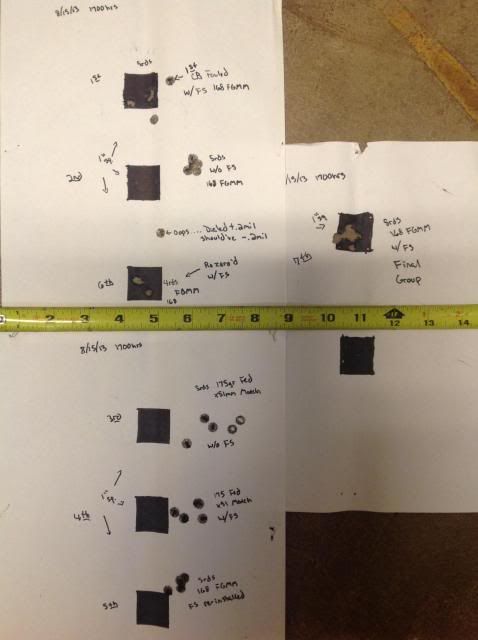
|
|
Thanks for the feedback Safetyoff, it is always good to have someone to run the discussion back & forth with to try and keep me honest & on point.
Since I don't always get what is in my head down here in the post the same way, let me try some of this again: Back to the OP originals question, what is happening to his groups with the addition of a muzzle device? Rule 1 - change anything that impacts the barrel (muzzle device, accessories mounted to it, pressure points, etc) and it may well change the performance in some way (group size, POI, etc). That potential level/degree of change can vary greatly from something as simple as a minor POI (point of impact) shift that can easily be compensated for, to something significant like group size doubling, which you can not correct for due to an issue like Rule 3. Rule 2 - the lighter & longer the barrel, the greater the chance that any changes in Rule 1 will change the performance in some way. Barrel profile is usually a very good indicator/predictor of barrel behavior. The heavier and shorter the profile, the less susceptible the barrel will be to changes, and the greater the chance that performance levels will remain consistent. Rule 3 - any muzzle device mounted to the end of the barrel should be mounted concentrically to the bore. A minor deviation could produce a minimal POI shift that can easily be compensated for. A major deviation could produce something significant like group size doubling, which you can not correct for. Problems with concentricity could be the fault of the barrel, muzzle device, or both. Rule 4 - anything that the bullet passes by (crown, muzzle device, etc) can impact its stability & flight path. Remember the bullet does not have to actually contact/strike anything to change its behavior, encountering uneven gas pressures as it exits the barrel can be significant enough to influence its stability and/or flight path. Just remember, that for every Rule, there is usually some form of an exception, which is well beyond a simple reply here! In terms of the OP's situation, any of the above could be responsible for a change in performance. The key is to break each element down, and try and determine what is going on. A Gunsmith can address Rule 3, just make sure they check both the barrel and muzzle device. The remaining Rules come down to identifying the change(s) in performance levels, trying different things to tune or change the interaction of the load with the barrel/muzzle device (increase or decrease muzzle velocity, change bullet types, etc), and seeing if you can come up with an acceptable resolution? Also to clarify, I was not trying to say that one type/design/model of Muzzle Device was inherently more accurate than another, though some manufacturers would argue that is the case! The point that I was trying to make is that the muzzle devices with the more radical/non-symmetrical/directional designs, tend to impact performance in some way (group size, POI, etc) when added to a barrel. That is to say, going from shooting without the muzzle device, to then shooting with the device added to the barrel. That is also NOT to say that the change will necessarily be negative, there just may be a change in performance going from shooting with no muzzle device to shooting with a muzzle device. I have seen a properly mounted suppressor open up a group, and I have also seen them shrink a group. I have seen a muzzle device on a rifle (light hunting rifle) change the performance level, to see the same muzzle device on another rifle (heavy target rifle) have no impact on the performance. Some changes in performance are very minor and can be easily compensated for, other changes are very significant and can not be compensated for. In some situations the changes may be very predictable, and in others you will not ultimately know what you are going to get until you try it. Each situation has a number of potential variables which can come into play, and it is very important for them all to be taken into consideration. Personally, I had a rifle that would put 10 rounds into a sub MOA ragged hole at 200 yards. I mounted a suppressor on it, and the group size doubled/tripled. I tweaked the load, and got it back down to around 1 MOA, but it was not as good as it was before the suppressor. I had a Gunsmith triple check that everything was 100%, and it was. Whether it was barrel harmonics, gas pressure variations on exit, or something else, the performance level was just not going to be the same. To me the accuracy level was more important that running suppressed, so I ditched the suppressor, and went back to just a straight barrel, and I was able to get back to the previous level of performance. Conversely, I had a factory rifle that would consistently shoot 1 MOA groups with a straight barrel. I had it threaded and added a JEC Brake. Using the same load, the group size did not change, but I had a POI shift which was easily compensated for. I decided to try and rework the load, and was actually able to get a slight improvement in the group size by changing the powder charge. IMHO, if accuracy is your ultimate driving goal, then the "KISS principle" works very well, and that is don't do anything other than run a straight barrel! Not sure if that will help, or just muddy the waters more? *EDITED for additional information/clarification, because I shouldn't type posts at night when I am half asleep! |
| Yeah, I think its coming down to me just needing to buy a reloader, that way I can compensate for any changes on the gun. The barrel is a savage barrel, model 10TR, factory threaded. Its a little more than 0.82 at the muzzle, and its 20" barrel. I just think I need to reload because from what I've been reading, even 1/10th of a grain can change your results for the better. |
|
Quoted: Thanks for the feedback Safetyoff, it is always good to have someone to run the discussion back & forth with to try and keep me honest & on point. Since I don't always get what is in my head down here in the post the same way, let me try some of this again: Back to the OP originals question, what is happening to his groups with the addition of a muzzle device? Rule 1 - change anything that impacts the barrel (muzzle device, accessories mounted to it, pressure points, etc) and it may well change the performance in some way (group size, POI, etc). That potential level/degree of change can vary greatly from something as simple as a minor POI (point of impact) shift that can easily be compensated for, to something significant like group size doubling, which you can not correct for due to an issue like Rule 3. Rule 2 - the lighter & longer the barrel, the greater the chance that any changes in Rule 1 will change the performance in some way. Barrel profile is usually a very good indicator/predictor of barrel behavior. The heavier and shorter the profile, the less susceptible the barrel will be to changes, and the greater the chance that performance levels will remain consistent. Rule 3 - any muzzle device mounted to the end of the barrel should be mounted concentrically to the bore. A minor deviation could produce a minimal POI shift that can easily be compensated for. A major deviation could produce something significant like group size doubling, which you can not correct for. Problems with concentricity could be the fault of the barrel, muzzle device, or both. Rule 4 - anything that the bullet passes by (crown, muzzle device, etc) can impact its stability & flight path. Remember the bullet does not have to actually contact/strike anything to change its behavior, encountering uneven gas pressures as it exits the barrel can be significant enough to influence its stability and/or flight path. Just remember, that for every Rule, there is usually some form of an exception, which is well beyond a simple reply here! In terms of the OP's situation, any of the above could be responsible for a change in performance. The key is to break each element down, and try and determine what is going on. A Gunsmith can address Rule 3, just make sure they check both the barrel and muzzle device. The remaining Rules come down to identifying the change(s) in performance levels, trying different things to tune or change the interaction of the load with the barrel/muzzle device (increase or decrease muzzle velocity, change bullet types, etc), and seeing if you can come up with an acceptable resolution? Also to clarify, I was not trying to say that one type/design/model of Muzzle Device was inherently more accurate than another, though some manufacturers would argue that is the case! The point that I was trying to make is that the muzzle devices with the more radical/non-symmetrical/directional designs, tend to impact performance in some way (group size, POI, etc) when added to a barrel. That is to say, going from shooting without the muzzle device, to then shooting with the device added to the barrel. That is also NOT to say that the change will necessarily be negative, there just may be a change in performance going from shooting with no muzzle device to shooting with a muzzle device. I have seen a properly mounted suppressor open up a group, and I have also seen them shrink a group. I have seen a muzzle device on a rifle (light hunting rifle) change the performance level, to see the same muzzle device on another rifle (heavy target rifle) have no impact on the performance. Some changes in performance are very minor and can be easily compensated for, other changes are very significant and can not be compensated for. In some situations the changes may be very predictable, and in others you will not ultimately know what you are going to get until you try it. Each situation has a number of potential variables which can come into play, and it is very important for them all to be taken into consideration. Personally, I had a rifle that would put 10 rounds into a sub MOA ragged hole at 200 yards. I mounted a suppressor on it, and the group size doubled/tripled. I tweaked the load, and got it back down to around 1 MOA, but it was not as good as it was before the suppressor. I had a Gunsmith triple check that everything was 100%, and it was. Whether it was barrel harmonics, gas pressure variations on exit, or something else, the performance level was just not going to be the same. To me the accuracy level was more important that running suppressed, so I ditched the suppressor, and went back to just a straight barrel, and I was able to get back to the previous level of performance. Conversely, I had a factory rifle that would consistently shoot 1 MOA groups with a straight barrel. I had it threaded and added a JEC Brake. Using the same load, the group size did not change, but I had a POI shift which was easily compensated for. I decided to try and rework the load, and was actually able to get a slight improvement in the group size by changing the powder charge. IMHO, if accuracy is your ultimate driving goal, then the "KISS principle" works very well, and that is don't do anything other than run a straight barrel! Not sure if that will help, or just muddy the waters more? *EDITED for additional information/clarification, because I shouldn't type posts at night when I am half asleep! Well written Captrichardson, however you forgot to throw murphy in the equation of variables, that fellow tends to pop up every now and then.  Yes I mistook some of your statements in the earlier post, this clarified it well.  |
|
Quoted: Yeah, I think its coming down to me just needing to buy a reloader, that way I can compensate for any changes on the gun. The barrel is a savage barrel, model 10TR, factory threaded. Its a little more than 0.82 at the muzzle, and its 20" barrel. I just think I need to reload because from what I've been reading, even 1/10th of a grain can change your results for the better. Reloading is can be a great benefit to accuracy and it is a satisfying step deeper into the firearms world. As far as your issue with the muzzle device, after the above explanation, my guess is that your factory threads are not concentric with the bore, and 99.9% of the time they are not concentric 100% of the time. It is not an issue until you screw something onto the end of the barrel then you will see the effects of turbulence and inconsistent harmonics. If this is the case changing your load or reloading is not going too solve the problem. You will need to let a KNOWLEDGEABLE rifle builder (not local shop gunsmith) look at it and if needed cut, thread and re crown the barrel. ESPECIALLY before you send a bullet through your suppressor. You don't want a baffle strike after waiting 9 months for your suprressor, and what it appears you have is exactly what causes it. best luck getting the problem fixed up. |
| Ok, so I went shooting yesterday. I checked the muzzle crown and everything. It all was fine. The temp yesterday when I was shooting was 72 and dropping. Last time I shot it was in the high 90s. So I'm pretty sure the problem was me being hot as crap when I was shooting, and the temperature. I was shooting subMOA at 400yds |